Total Pageviews

Thursday, January 8, 2009

KiwiSaver - a mess

KiwiSaver is a basically flawed system and is only a good investment for someone in the 19.5% tax bracket (who is unlikely to have money to invest).

Firstly, the government uses our own tax money to entice us into the system. They then must either:
a) collect more taxes*
b) reduce services.
c) or put us into greater debt.

*Question: Could the 2010 proposal by the government to raise GST be due in some part to the money they use for KiwiSaver bribes.

Secondly, the employer contribution isn't. A CEO will simply calculate how much he can afford to pay his new employee, deduct his contribution and offer the remainder. For employees already working, salaries won't rise as fast as they otherwise would have. Same result. The CEO's have been given 4 years to adjust which is plenty of time to make sure KiwiSaver doesn't cost them anything. The present economic crisis presents the perfect excuse not to increase salaries.

Thirdly, and most important, KiwiSaver is a very poor investment. Consider someone in the 33% tax bracket. Contributions are after taxes (unlike many other countries) so our middle income investor has to earn $150 in order to have $100 to invest. Then his interest and/or dividends are taxed. I am somewhat disillusioned with capital gains and anyone who would put money with a New Zealand investment company must have been sleeping for the past 5 years. I would rather have a 6% fixed interest investment in the bank which is is easily obtained in normal times when inflation is running around 3%. Lets use this as an example.

At age 20 I invest $100. I get 6% so at the end of the first year I have $106 in the bank. I earned $6 so the government takes $1.80*. I gain $4.20 from an investment of $100. With 3% inflation, I need $103 to break even. Real earnings $1.20 or 1.2%. At that rate it will take over 34 years to get back to the buying power of the original money I earned. It is hardly fair to ask us to lock up our money for most of our life with almost zero return. Other countries have got it right. Why can't we.

*Note - the government has lowered the tax on dividends within KiwiSaver to 30% for people in the 33% and 38% brackets.

#Note also that to a significant extent inflation is controlled by a government. As inflation occurs, the buying power of money you have saved is reduced. In other words, without ever touching your bank account, the government is taking money out of it. A hidden tax.

Saturday, November 29, 2008

Clearing mines - a better way

Clearing mines and other ordinance left on the world's fields of battle is dangerous and expensive and is taking far too long for the farmers who want to get back on their land and farm in safety. Doing it by hand as is done at present is so slow that it will never be finished. I don't know if it is true but I have read that some first world war battle fields are still being cleared. All the unexploded ordinance and especially the mines are exerting a huge toll in life and limb amongst the innocents who didn't want the war in the first place. Why can't we mechanize mine clearing.

Start with a main battle tank such as the British Centurion, Israeli Merhava or Soviet T series tank. Strip it of the turret and gun and every bit of equipment that was necessary for battle. With the reduced weight we now have lots of spare power available. Weld on a cupola where the turret was located that can withstand the shrapnel from an exploding tank mine and equip it with the standard prism system so that the driver can drive in safety from within the tank.

Connect a realy grunty hydraulic motor to the main engine. Now we are ready to start.

Build a cylinder with teeth/ scoops which is a little longer than the width of the tank and suspend it on arms coming from the sides of the tank. The arms raise and lower the cylinder hydraulically to control the depth of cut. The cylinder is situated in front of the tank and rotates with the forward side moving upwards. A hydraulic motor rotates the cylinder at, say, about 60 revolutions per minute. The cylinder is robust enough to take the explosion of a tank mine. Remember, the mine is no longer tamped and its force can blow upwards and outwards. The cylinder scoops up the top, say, 50cm of soil and pushes it backwards over the top of the cylinder, dropping it into a vibrating grid made of really grunty steel bars. The mesh size is such that it catches tank mines. anti-personell mines and cluster munition. The grid has an orbital vibration so that anything caught is bounced off to one side and dropped in a windrow beside the tank. Anything surviving this rough treatment is exploded by a sapper.

Below this grid is a second grid of finer mesh that catches anything down to a M16 bullet. This material is also conveyed to the same side of the tank and sieved out material is dropped in the same windrow. The soil falls between the tank tracks.

Any valuables including brass go to the owners of the fields. They deserve some recompense for what they have suffered.

The driving compartment is air conditioned. Most of the battle areas of the world are tropical and the driver must be comfortable to be able to operated for many hours a day. Make the driving space like a modern agricultural tractor.

While we are at it, lets analyze the soil and if it needs something like lime or some nutrient to make it fertile lets add it to the discharging soil. Attach a couple of hoppers to the back of the tank and a metering system to add whatever is necessary to the soil. Once again, the farmers deserve something extra for their long suffering.

A grader attached to the mine clearing crew finishes off the cleared field

All finished areas are, of course, entered in a GIS map using GPS technology so in years to come, it is clear which areas have been cleared. Start with the most arable land so that the farmers can get on with their lives.

Surely the engineers that came up with battle tanks with all their sophistication could come up with a machine to clear mines rapidly and effectively. How great would it be if one of the engines of destruction, the main battle tank, was the platform on which they built such a system.

Sunday, October 19, 2008

Canadian Fedral Election system - ridiculous

Yes it is. It's ridiculous. We scorn the English election system of the 17th century with its gerrymandering and rotten Burroughs but the Canadian Federal Election system could give them a run for their money. For illustration lets look at the fate of the Green party in the 2008 election.

Greens got 6.8% of the votes. In the Canadian 360 seat parliament this should have translated into 21 seats. What did they get. Nada, Zilch, Not a single seat. Of course the reason is that they didn't win a single riding. Wake up people. This isn't a local election where you vote for your municipal or even provincial government. This is an election for the Federal government which will run the whole country. The will of the people has been totally ignored by the powers that be. Its even worse.

Throughout the election, the green party was polling around 10%. Are the polls wrong. Not by this much. Did you notice the vote swapping that went on before the election over the net. Why was this. Because people didn't want to waste their vote so they swapped votes to make their vote count. Similarily, in a specific riding where, say, liberal and conservative have always been neck in neck, someone who wants to vote Green will realize voting Green is throwing away his vote. Instead he will vote for liberal or conservative party depending on which one he dislikes the least. If the popular vote counted so that you could vote for who you really want in the government, Greens would have got 36 seats. This doesn't even tell the whole story.Italic

Even during the polling, some people will report the strategic vote they intend to cast rather than the party they really want to vote for. Who knows, the Greens might have got 40 seats or more. The same applies to all the other minor parties.

Major parties and most especially the party in power always trots out the line "give us an absolute majority so we can legislate effectively". Nonsense. The last thing you want in a country in which pretty reasonable systems are already in place which work pretty well is a majority government that can do what it wants. The major party should have to talk, persuade, negotiate, consult and in short, take a lot longer to make any changes to the existing system. Precipitous changes without considering the all-to-often contrary-to-expectation consequences is a recipe for disaster.

When are the Canadians going to wake up to the fact that they are being 'had' by their major political parties.

Saturday, September 6, 2008

Biodiesel From Algae - no way

The title of this blog is somewhat misleading. While this blog gives reasons why we will never manage to produce biodiesel from algae it could be thought of as a catalogue of the problems you would have to overcome to produce economic diesel from algae.

I would be the first to laud anyone who solved the huge series of problems and made us free from foreign sources of oil and while I think that pretty soon, we will be converting to electric cars for domestic transport, the powering of large transport trucks will be pretty close to impossible without concentrated liquid fuel. In-country production of biodiesel is something of a holy grail.

Producing bio diesel in, for instance, our deserts would be a fabulous thing to do and would stop a great deal of misery in the world. Look at the support of terrorism, using the discretionary spending of rich oil countries or the exploitation of their own citizens by leaders with obscene levels of richness at their command. How obscene is it that citizens of oil poor countries adjacent to Nigeria, for instance, are better of than citizens of oil rich Nigeria. Bio diesel from algae is a very worthwhile aim but virtually impossible. I hope I will be in the position in a few years of the sages that said heavier than air machines will never fly. I doubt it.

First lets look at what you have to compete with. The theoretical efficiency of photosynthesis from sunlight to chemical energy is about 6.6% although when the actual biomass is measured and compared with the energy which has fallen on a crop, you are lucky to come up with 3.5% as much chemical energy as fell on the crop as sunshine. Photosynthesis is a solar energy harvesting system, converting sun energy into chemical energy. Take a piece of desert, cover it with your algae ponds, tanks or whatever and the total chemical energy you can produce, in theory, is equal to 6.6% of the sun energy which falls on the site. Cover the same area with solar cells and you can collect about 20% of the energy even with existing solar panels. Put this energy into power lines and you can charge up your car batteries. I know that a practical electric car is not yet commercially available but I believe it is just around the corner. Batteries and electric motors are pretty efficient and from solar to wheel you can probably count on a 10% energy conversion. Lets look at our algae cultures again and remember solar-electric farms will be in competition with solar-algae farms for such sites. Of course, solar electric 'farms' need no water.

The chemical energy in the algae cell is not all oil. Some algae cells will store oil as a food reserve in vacuoles inside their cytoplasm but they also need to produce the protein, carbohydrates cytoplasm, nucleoplasm and outer coating of their cells. Lets be generous and say that half of the energy is in oil and half in the rest of the cell. We are down to 3.3%, even if we use the theoretical maximum energy conversion figure or about 1.5% if the more usual observed conversion figures are used. Actually this could be an advantage. After extracting the oil, a lot of "algae pulp" is left and could be a source of a range of valuable products. Perhaps bio diesel could be a by product of the production of some other more valuable product. Even more likely is that the algae could produce oil for massage, pharmaceuticals or specialty lubrication, all of which have a higher price than diesel oil. However, this is not giving us cost effective fuel.

Back to the bio diesel. To grow significant amounts of oil producing algae, your sun collecting area (pond, tank tubules etc will have to be measured in hectares or more likely in square kilometers. You can forget about growing pure algae cultures in such circumstances (there is a small possibility mentioned later that might render this statement incorrect). To sterilize the required quantities of water is simply too expensive and you only need a few cells of a wild algae to get into your culture to crash it. All is not lost though. There are a couple of possible techniques known and probably more that have yet to be discovered.

You can grow extremophyles. These are algae which grow in such harsh conditions that other algae die. Spirolina grows in high concentrations of bicarbonate, Dunaliella grows in high concentrations of salt and certain algae found in hot springs grows in temperatures too high for other algae. So if you can find or engineer an extremophyle that produces oil, you may be able to produce oil from hectares of algae culture. A slight glitch in this scenario is that extremophyles are at the limit of their growth conditions and are not the fastest growing amongst the algae. This further cuts down the total percentage of the incident radiation that can be harvested.

You now have the problem of temperature. Obviously you have to grow the alge with sunshine. That is the whole purpose of the exercise: namely to use sun energy and turn water and carbon dioxide into diesel oil. This virtually ensures that you will be growing your algae in a desert and probably close to the equator which receives the most sun energy per unit of area per year. If you are turning 6% of the incoming energy into biomass and reflecting a bit too, you will have around 90% of the incoming energy being absorbed by your culture and heating it up. Algae and most poikilothermic organisms grow best a little below their lethal high and for the best production it is best to keep the temperature of the culture up there. In an open culture, much of the cooling is taken care of by evaporation.

Sun energy is about 1kilowatt per square metre with about 5 peak hour equivalents per day in desert areas. This amounts to 5kWh per square metre per day and if 90% of this energy heats up the water rather than producing biomass you have a severe cooling problem. This amount of heat will evaporate about 10mm of water and this amount of make up water will have to be found. Closed cultures are impractical since you would have to refrigerate to keep the temperature below the lethal level and circulate the water rapidly past the cooling coils to avoid heat stress. Evaporation can be a great help in bleeding off this excess heat. Another help is to have deep, well mixed cultures. The deeper the culture, the less a certain amount of heat will warm up the culture. Then at night, the culture can radiate heat out into space, starting the next morning at a cooler temperature. The depth is not needed to grow the algae. After the algae achieves even a modest concentration, only the top few cm of the culture is photosynthesizing. The rest of the depth is for temperature control and you must pay the extra construction costs. Of course the algae is distributed throughout the depth of the culture so you must agitate to bring all the cells up to absorb sun energy. Another energy expense.

A further problem with temperature occurs at night. Areas suitable for algae culture will generally have clear skies at night. In the middle of the Sahara, a container of water will freeze at night due to radiative cooling. Cultures are likely to be well below their optimum growth temperatures in the morning. They will be close to their lethal temperature in the afternoon. Only a small part of the day is at the best growing temperature.

Now you have to separate the algae from the water medium. Filtration of independently living single cell algae is not practical except on a small scale. filters plug up much to quickly. An alternative is centrifuging. This works but uses a huge amount of energy in relation to the amount of product separated out. The energy use is from the acceleration of large amounts of water from zero speed to high speed. Once it is up to speed, not much energy is used and the algae separates out.

There is one bright spot in this scenario, though. Some single cell algae stay connected in chains and these can be separated from the water by reletively simple, inexpensive filters.

There is one filtering (or rather concentrating system) that might be practical. If you can persuade your algae to sink or float. Plate separators are very efficient in concentrating such materials with minimal energy inputs. Once separated, the algae must be processed to extract the oil and if you want diesel, it must be chemically converted. Diesel engines can run on pure oil with some modification so the conversion stage could be eliminated.

Once produced, the diesel enters the existing distribution system with already known energy costs.

As I said at the beginning, I would be chuffed beyond belief to see practical bio diesel from algae but the only possibility I can see is if some natural system such as a eutrophic lake is naturally producing a type of algae that washes up on the beach and only has to be processed. Even then, The energy costs vs the energy you obtain are likely to be uneconomic. For an algae system to be economic, you have to be collecting more energy than you are using and you have to out compete other potential users of the same piece of real estate that could produce more usable energy from the same location.


Saturday, July 5, 2008

Beavers in BC - observations and speculation

In June 2008, I was fortunate to travel in BC to visit friends and relatives. Unfortunately time was far too short but we managed to see a fair few Beaver locations and Salmon facilities. We started in Abbotsford near the head of the Frazer river delta, stopped at Hope; Through the Hope Princeton Highway to Kelowna; From Kelowna through Williams Lake to Prince Rupert; On the ferry from Prince Rupert to Port Hardy at the north end of Vancouver Island; Down to Nanaimo on the inner coast and then to Sook on the south west coast. From there we took the ferry from Victoria over to Tawassen and then back to Abbotsford.

With the time available and the distance to be covered, there wasn't a lot of time to check thing out and make careful observations so take the following with a grain of salt. However, in geographic order:


Hope
Bridge over artificial spawning canal in Hope, BC
Hope is a short way up the Frazer River. The Coquihalla River joins the Frazer at Hope. If you want to see a lovely little site, turn off on to the old Hope Princeton Highway which runs parallel to the new Vancouver-Princeton highway. Find Seventh Street. Walk or drive down seventh street and look for a big H sign. This is a signposting to the hospital. Turn right and you will find a little road bridge. Stop at the parking lot on the right. That bridge goes over a little stream which is actually an artificial spawning channel. It looks so natural that you would think it is a stream. Walk a little way down stream and you will come to a place where it empties back in to the coquihalla river. The reason I mention it here is that we were told that there is a beaver dam upstream in the spawning channel. We didn't have time to check it out but maybe someone who reads this might have a look and write a comment.


Kelowna
Beaver nibbling vegetation in lake side wetland in Kelowna
My uncle Arthur has been instrumental in establishing and running a couple of wetland/bird sanctuaries in Kelowna. The first is Water Front Park just north of the exit from the bridge that crosses the Okananan lake. Turn North on Water street. The road turns East (right)on to Clement Ave and you immediately turn left on to sunset drive. Past the buildings on the left you see open water. That is it. Turn left. This reserve is right on the shore of the Okanagan Lake in front of an apartment complex. It has an artificial osprey nest site which was occupied
almost before it was properly erected. A board walk allows you to walk around dry shod. You will notice almost all the trees are ringed with chicken wire. You can guess why. My wife thought she saw something brown and furry in the shadows across the water so she put her camera on maximum telephoto, steadied it on the rail of the boardwalk and shot a couple of pictures. Sure enough, when we put it on the TV screen there was a beaver nibbling on some branches that had escaped the chicken wire. Apparently beaver live in the Okanagan Lake because trees are cut down on the shore from time to time.


Art then took us to the bird conservation park. It is also right on the shore of the Okanagan Lake and also has a nice board walk that you can use to keep dry shod. As we crept along, we saw a turmoil and a splash in shallow water just below us. A ripple formed and something swam under water. Another beaver. About 20 meters further on he hauled out of the water, sat up on his hind legs and proceeded to eat some twigs. Here also most of the trees are protected by chicken wire so the beavers have to take what they can get. So much for beavers being nocturnal. I'm sure they are but they aren't shy about coming out in the day if they feel safe.

After a few days in Kelowna, we headed up towards Prince Rupert. Art put me on to a most amazing book that I must tell you about. It is called Three Against the Wilderness by Eric Collier. Eric married a quarter Indian girl, Lillian and had a son, Veasy. Lillian had a full blooded Indian Grannie, Lala, who she looked after. Lala was very old and she knew a thing or two. She told her grand daughter and Eric to go up to the headwaters of Meldrum Creek where she had been raised and bring back the beaver so the other animals would return. When they had finally cut their way through with their wagon, they found nothing but coyotes to trap to keep them in the cash they needed for store bought goods. Almost nothing lived in the high Chilcoten plateau where once there was an abundance of life. I won't spoil the story for you but suffice it to say that they did bring back the beaver. If I was to say the results were spectacular I would be guilty of gross understatement. What is most amazing (for us whites who think we are the repository of all knowledge of any value) is that Lala knew what we are just discovering back in the late 1800's.

Old beaver cut stump in headwaters of Meldrum Creek
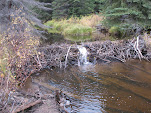
We tried to get up to Collier meadows but missed on our first try and had to get on to an appointment with some Grizzly bears but that is another story. Perhaps anyone who has visited Collier meadows could add a comment to this blog. On Google Earth, many of the locations in the area where you would expect beaver ponds are empty. I wonder if the ecosystem that Eric, Lillian and Veasy reestablished is still in good shape. It will depend on whether the beavers are still there. The picture of the old beaver cut stump is taken beside one of the dams that Eric and his family rebuilt before they received their first beavers. It is probably decades old and was the only trace of beavers that we found by that dam.

On a trip shortly after that, we managed to drive up to the head waters of Meldrum Creek. While we didn't have a lot of time to explore, the beavers were gone and only traces of previous activity were left. I don't know if this is the case for all the area where Eric lived and worked but if it is, it is very sad and in need of some explanation as to what has happened.

We continued on our way to PR. After dinner we went for a walk across the bridge on Lake and along the far shore. Suddenly we were startled by a rifle shot. Only it wasn't. It was a beaver slap. It wasn't long before we discovered through the light screen of trees a beaver patrolling back and forth on the lake. We got him to slap again but after that he seemed to work out we were no threat and ignored us. I think he either had a den in the mud of the shore or wanted to get to the succulent shore side alders to eat. A number of them had been beaver felled so he obviously ate there sometime. We saw no sign of a lodge.

All along the rout up to Prince Rupert there are many ponds and small lakes along the road and many more further away from the road. In our mad dash for Prince Rupert, we saw a number of beaver lodges but no beaver dams. Whether this was due to not being able to get out and look around properly or because the beaver population has not yet expanded to the point where they need to build dams in order to have a suitable habitat, I don't know. It could also be that people are destroying beaver dams. We found ambivalent attitudes towards beavers, even amongst some fisheries biologists and evidence of some hunting of beavers for their pelt. In the Indian (First Nation) museum in Prince Rupert we met a chap who assured us that the pelt on display was beaver and than he had many in the freezer waiting for processing.

Fall scene in Chilcoten, BC,  Poplars are replacing pine
Another interesting thing we saw was the beginning of the demise of the pine forest. Wherever you had a view of a mountain side, there would be the dark green of the pine trees with swaths of red brown dying trees and the autumn yellow of the changing leaves of the poplars. Apparently the Pine Beetle, which we were told had always lived in the forest, is spreading a fungus that is decimating pine trees. The prevalent theory is that the winters are no longer hard enough to knock back the pine beetle populations. I can believe it. Eric Collier talks about winters of 50 below and more. All through the forests were veins of light green. These were poplar trees which apparently are the pioneer species which is replacing the pines. Some alders were also seen here and there along the road verges. This is hard on the logging industry which is dependent on the pines but one has to wonder if it won't result in a much more interesting ecology. Pine forests are sterile places with sour soil and not much growing on the forest floor. Deciduous forests have rich dark soil from the yearly leaf fall, all sorts of bushes in the understory and a far richer population of animals. In addition, beaver can use poplars for food and construction so their just may be a resurgence of beaver dams from the nucleus population we saw throughout the area. With the beavers will come all the other animals mentioned in Three Against the Wilderness and perhaps eco-tourism or something else will replace logging as the prime money spinner in the area. The preponderance of Evergreens might actually be the explanation for the lack of new beaver dams and if so, this is about to change.

On up to Prince Rupert to see the Grizzly bears in the Kotsamatine reserve. Glad we were looking from a boat. Prince Rupert has one of the most beautiful beaver sites I have seen right withing the city limits. If you are coming from the ferry you will see an RV camping ground on the left. A little further on, there is a motel/hotel with a path just before it going down into a little valley. Follow that path and you will come to Moris lake in Morsby park. The lake (large pond) has been created by building a cement weir across its lower end. A fish ladder allows salmon to come up into the pond. What is amazing is that there is a main highway on one side and a housing development on the other side. The tops of the houses are visible from the path that runs along the side of the pond. Beavers have built a lodge on the far side of the pond right up against the shore and a couple of food piles further into the pond. We watched the beaver swim over to our side, grab a Lilly pad leaf in its paws, scrunch it up and eat it from one end to the other like a carrot. A little later it was patrolling back and forth in front of us and as soon as my wife had begun to video it, I waved my arms and we recorded a good beaver slap. We managed to get a second slap and then the beaver got bored with the game and ignored us.

If you walk up the path beside the stream that feeds the pond, you come to the RV park (camping ground). Here at the end of the camping area is another beaver pond. It is hard to recognize the dam as it is very old and grown over with vegetation. The pond is still full of dead snags from when the pond area was flooded originally. Recently the beavers tried to build another dam on top of the old one but the owner got the parks board to remove the beavers and the dam. What a missed opportunity. Can you imagine the draw card an active beaver site would have on your RV tourist who is getting more and more ecologically conscious all the time. I should mention that the camp operators have put large piles of rubble where the path from Morse Pond comes to the RV site. This makes the beaver pond beside it a bit hard to access unless you are a customer in the RV camp. The silly thing is that they have lots of free board so the beavers could build a considerable dam without any danger to the camp.

We see signs all over North America that people are beginning to realize the benefits of having beavers in the ecology (creating the ecology might be more accurate). As people who have woken up and realized what effect the beavers have, we can only keep up the gentle pressure. We certainly don't want to alienate people and get their backs up. Getting a copy of Grey Owl for them to read or show to their children or getting a copy of Eric's book for them to read are a couple of measures we can take. And if we can take a class of school children to a local beaver dam and talk to them really quietly so as not to disturb the beavers maybe we can convert them at a young age. Wanting to destroy beavers and their works is simple ignorance and ignorance is only countered by education.