Total Pageviews

Wednesday, July 15, 2009

Terra Preta - how does it work


Fairly recently fertile zones along the Amazon river were discovered. These are places which are rich in charred organic material and are fertile zones in an area of very poor soils. The depth of black soil is typically half a meter. In case this sounds strange to you; that the soils of the amazon jungle are poor, perhaps some explanation is in order.

You would think at first glance that the soils of the Amazon must be very rich to support such a large biomass of such rich flora and fauna; a veritable jungle. Apparently not so. If you cut down the jungle or burn a patch of it, you can plant some crops and if you are lucky you will get a couple of crops before you have to move to a new location.

If you do the same thing in the forests of Eastern North America as the Europeans did when they arrived, you could plant crop after crop in the rich deep dark soil before you have to start to fertilize. So what is the explanation for the incredible quantity and richness of flora and fauna in the jungle.

 The explanation is partially in the ability of the trees and plants to recycle all the nutrients that fall on the soil. Animals and plants die, Animals defecate and urinate on the forest floor and with the high rainfall, humidity and temperature. all this material is mineralized (changed back into phosphates, nitrates and all the other ates) and is taken up by the roots of the growing flora. So why isn't there an accumulation of rich dark soil as there is in temperate zones.

The answer apparently is in the relative temperatures of the two areas.

When the temperature of the soil is above 25degrees centigrade, in the presence of moisture, humus breaks down. Humus is the refractory material that is left in temperate-soil when organic material breaks down. The humus is the part that doesn't break down.

 It is physically sticky and helps in the  formation of the crumb structure (peds) of soil which allows paths for aeration and water penetration. It holds large quantities of water which plants can draw upon. Of great interest, it chealates (binds loosely) a variety of plant nutrients. If there is a source of nutrients coming from, for instance the breakdown of plants or animals, the humus will hold these nutrients in the upper layers of the soil and keep them from being washed into the subsoil.

Humus is a little like the haemoglobin in our red blood cells. Haemoglobin can hold a lot of Oxygen but not very strongly. In the lungs where the Oxygen concentration is high, it absorbs oxygen and in the body where the oxygen partial pressure is low, it releases it. Humus does the same with water and nutrients. below 25 degrees, humus is very stable.Link

So now we come to Terra preta and why it works. Terra preta has been formed by generations of humans charring organic material and incorporating it into the soil. Along the Amazon, where these soils exist, the black layer is often about half a meter deep. Any of you who have done organic chemistry know how charcoal is used to remove odors and colors from liquids. Charcoal is very good at adsorbing molecules on to its surface and releasing them. This is apparently the explanation for why all this char makes the soil so rich. 
 
 It is not that it has much in the way of nutrients itself but it can hold nutrients just as humus does in colder climates. If the farmers along the Amazon, for instance, net a bunch of fish and dig them into their terra preta, they will break down and the nutrients will be held by the soil instead of being leached out by the rain. And charcoal is very stable at high temperatures unlike humus. 
 
One wonders how they arrived at the idea. Perhaps they observed good growth of their yams or whatever, in a place where there had been a fire that was put out by the rain. Char also has some of the other properties of humus such as water retention and improvement of soil structure. Some careful work is necessary to tease out the finer details of how charcoal works in warm soils. In a way, char (charcoal) is the humus of the tropics.
 
There is a further use of charcoal in cooler climates.  Our farming methods have released the carbon that was stored in virgin soils all over the world.  While proper farming methods restores this carbon*, precious little proper farming is practiced world wide.  Charcoal can be incorporated into temperate soils and quickly increase the carbon content of soils, while sequestering carbon for very long periods.  All that is needed is an economic source of charcoal.

*  Read The Omnivores Dilemma, by Michael Pollan, starting at chapter 10 or Growing a Revolution by David R Montomery.

Thursday, July 2, 2009

The Luddites had a point

The Luddites had a point. They were a group of artisans who wove cloth and socks in home industries in the early 1800's. When the mechanized loom was invented which could produce far more cloth with unskilled labour, the artisans formed the Luddite movement and went around destroying the mechanical looms. It became a hanging offence to do this and hence the name Luddite was apparently not the name of their leader although that was what the authorities assumed. Clearly it was not healthy to let the authorities find out who you were. Notably, they only destroyed looms of factories that undercut their prices. Factories that kept prices up to a level that allowed the artisans to compete were left alone. At present the word Luddite is applied perjoritively and rather unjustly to anyone who is against progress of any kind.


So now most of our cars are mainly constructed by robots, any plastic utensil is made by a huge machine with one operator and turns out thousands of items per hour and even the pieces of wooden furniture are to a large extent produced by machine and at the most, assembled by humans. On our road to utopia goods are produced more and more cheaply making them more affordable for us all but.....................

We still need money to buy them. Where do we get the money if none of us has jobs and for that matter, if we can get the money somehow, what are we going to be doing to the environment if everything is cheap. We will be (are) cutting down more and more trees to make furniture that we can all afford, mining more and more irreplacable minerals to produce cheap cars, extracting more oil to burn in our cars and to make our plastics, mining more rare earth metals for our electronics and so forth.

What has actually happened is that most of us have become employed in the service industries. Everyone is servicing everyone else while capital is making the big money. Services include everyone in the tourism business, politicians, writers, sex workers, most government employees soldiers and a raft of others. All of this still leaves a lot of people unemployed or under employeed. What do we do with them. We still have to get money into their hand somehow so that they can buy the products produced by capital and keep the whole system operating.

Some we put some on welfare. They get a dole-out from the state which has got it's money by taxing income from wage earners and from the earnings of capital. From, say, the sale of plastic collanders that have been produced by their tens of thousands from a single maching with a single operator.

Some we put in the army. This is especially valuable to a capital intensive country which can produce far more than they use and produce it very cheaply. The army produces nothing of value, burns up fuel, destroys vehicles and blows up munitions. It keeps the taxes flowing from the government into salaries and back into factories which can continue to produce as the government uses up their production. It necessitates mining more minerals, extracting more oil, carring out research and many more activities to keep the army operating. Of course an army has to have a war from time to time to use up all this excess production and make room for producing more. I have read an estimate that one in every ten dollars in America is earned providing something for the armed services. Imagine if there was no army airforce or navy. Unemployment in America would be huge. Of course an army has the slight dissadvantage that it kills people in far away countries who, with a complete lack of appreciation of the way the world works, object to being killed. They fight back and kill our good old boys both in their country and in ours which is most unfair. Of course this provides employment for a raft of other services such as undertakers, spys, security guards, and the manufacturers of a host of metal and explosive detectors. Full employment for all.

Thursday, June 18, 2009

Swine Flue - Keep it weak

Abstract
Medical Officers don't stand a chance. (New Scientist, 20Jan, 2012 p28) If they stop a pandemic dead in its tracks, they will always be accused of overreacting.  If one gets away from them they will be accused of too little too late.  It is very likely that the very act of quarantining flue victims and their contacts is what avoided an H5N1 disaster.  A flue strain is deadly when it attacks the body so quickly that the body doesn't have time to create the appropriate antibody, a process that takes a week or so.  If you quarantine a victim with a deadly flue strain and his contacts as soon as he shows symptoms, he can't pass his variety of flue on to others.  In the mean time, people with more benign mutations of the same H5N1 virus that doesn't create early harsh symptoms and that  the body can handle are infecting others.  Any strain you contract of the same virus gives you immunity to all strains.  The next time the same flue comes around, from the viruses  'point of view', there are far less people for it to infect.  With an effectively reduced population, there is an added selective pressure for flue varieties that are more benign and can infect other victims before symptoms show in the infector.  This is likely the explanation why deadly diseases become less deadly the more time they are in contact with their human population.  We have to stop accusing the authorities of over reacting and continue to quarantine flue carriers and their contacts as soon as they are detected.  The more of us there are and the more crowded together we are, the more important this becomes.

It is reasonable to believe that the actions being taken around the world to limit the spread of swine flue is keeping it from becoming lethal.

When the flue virus enters a new human host, it takes over the genetic replication mechanism of some of the host cells and uses them to produce more virus particles. In the mean time, the body begins to ramp up its immune system to produce antibodies to kill the virus. The virus has to spread to a new host before the host produces enough antibodies to kill it or before the host dies. Typically antibody production takes about a week. The virus is therefore more successful (spreads to more hosts) if it spreads easily and if the host remains infectious and in contact with oters for as long as possible. To remain infectious, the host has to remain alive. Not only do viruses die in a dead host but a dead host is not moving around infecting new hosts.

Once a new virus has mutated to solve the problem of transfer from human to human, it begins to spread. The virus is not consciously motivated, of course and some of the viruses will mutate into a deadlier or less deadly form completely at random. Its chance of mutating depends on how many virus particles there are. If only a few humans are infected, there is less of a chance that a virus will mutate than if there are huge numbers of carriers. This is the first way in which limiting the spread of the virus mitigates against it mutating to a more lethal form. By limiting the number of humans infected, you limit the number of viruses available for mutation and hence you reduce the chance of a lethal form popping up.

However, given time, some viruses will mutate into a deadly form. Lets say for the sake of argument the frequency is one in a billion billion billion viruses. When such a virus infects a person, the symptoms will be severe and the person is likely to die. Here is the second way that slowing down the spread of the virus keeps it weak. If every time someone has visible symptoms, he is isolated, he will get better or die without his variety of the virus spreading to a lot of other hosts. Isolate his contacts and you further limit the chance that a lethal variety will spread. By killing its host the virus "burns itself out". In fact, the only virus that can spread freely is one that is mild enough not to force the host to stay quarantined. The ultimate, genetically successful virus would be completely asymptomatic.

So varieties of the virus which manifest themselves with mild or even no symptoms will stay out there spreading through the population. Here is the next reason why slowing the spread of the virus reduces its lethality. The longer you keep nasty varieties from spreading, the more time there is for the mild varieties and even asymptomatic varieties to spread. Remember that these mild varieties are also imbuing their hosts with immunity to this whole cohort of viruses (in the recent case, the H5N1 of 2009). Here there are two effects. First, a host that has been infected by a mild variety won't later contract a deadly variety and secondly, the more people that are immune, the greater the herd immunity and the slower the virus will spread when it comes through the second time.

In a thin host population, any virus which becomes deadly will burn itself out. By killing it's host, it kills itself. If it is killing the host before it can infect at least one and a bit new hosts, then it will disappear and only more benign forms of the virus will carry on - namely those which allow the host to live long enough to infect more people. In our modern world, we are particularly vulnerable. We are very crowded which gives many opportunities for the virus to spread to new hosts and methods of transport give many opportunities for the establishment of new foci in other geographical locations. Remember, that if the person can be kept isolated for a week or so, they will no longer be infectious. Then another factor comes into play.


Here and there, though, a virus will arise by mutation that is deadly. It will kill its host quickly. If we take no precautions to slow its spread, in a crowded population, a huge number of people can become infected before the first person dies. If, however, we take extraordinary precautions when someone dies from the virus, regardless of what we think of their vulnerability, we will tend to wipe out the deadly form. Extraordinary measures, of course, consist of trying to contact all the contacts of the victim and getting them to isolate themselves for a week. Of course with modern medicine; with life support systems and antibiotics to protect against secondary infections, mortality for the isolated people is much less likely than it once was.

And how about immunization. From the individual persons point of view, this is a good thing since they then can not be infected. From the point of view of the population, the more herd immunity that can be established, the slower the virus spreads, the less chance there is for a deadly form to spread.

I think it is a reasonable hypothesis that the very measures we are taking to slow the spread of the virus are keeping it weak (in terms of its lethality) and that we should continue. The main danger is if we stop the various containment methods. A fast spreading virus, if it become lethal, can kill huge numbers but it can only become fast spreading if we let down our guard. We must also treat any death from the virus as if the virus has become deadly and take extraordinary measures to isolate all contacts of the deceased person. It is counterproductive to hypothesize that the person was particularly vulnerable and that was the cause of death. In this case better to err on the side of caution.

Ocean Recovery

In a recent New Scientist, (May 30, 2009 p8) it was suggested that the human induced demise of fish stocks, both fresh water and oceanic, began long before the modern era. Many lines of enquiry are quoted to support this contention. This may well be so and would parallel the destruction of populations of land animals as humans invaded each new area. Be that as it may, modern humans with their technology have finished off the job quite nicely and we are now in the situation in the oceans that Southern Africa was before the whites woke up to the fact that most of the animals of their forefathers were just about to go extinct. They took the appropriate measures and at least, in reserves which they set aside, the fauna of Africa recovered. (it is now on the way out again)

With respect to the oceans, lets consider the problem from a different perspective; to explore a different way of thinking. We have, at a conservative estimate, destroyed at least 70% of the fish resources of the world that existed at the start of the modern era and in the case of, for instance, the Grand Banks off Newfound Land, even though fishing has been banned for decades, the fish resources are not recovering. Lets look at the problem from the point of view of primary production; from the point of view of phytoplankton.

Ultimately, the productivity of 99.9%+ of biological systems on earth is based on photosynthesis. The ultimate limit to productivity depends on how much sun energy falls on the system. This is something which we can not increase  Ultimately the limit to primary production is sunshine. The more of this sunshine we can absorb by building simple mollecules into more complex mollecules throught he agency of life, the greater the productivity of a system.

There is a principle in the growth of individual animals and plants and in the productivity of ecological systems that says that growth/increase/primary productivity depends on the most limiting factor; that is to say the factor which is in shortest supply in comparison with the amount which would not limit growth. In an ocean system, water is not limited and sunshine is whatever nature provides so the main limiting factor is the availability of nutrients. And the potential for production is enormous.

Look at, for instance, the water off Peru in non-El Ninio years. In these years there is upwelling of nutrient rich waters from the deep ocean. We don't actually see primary production (phytoplankton) or even secondary production (zoo plankton) but only tertiary production which in Peru takes the form of Anchovies. The fisheries is humongous and provides much of the fish meal for the world from this one small patch of ocean. This fish meal is used in feed for most land based domestic animals and in the huge fish farming (feed lot) industry.

Another relevant fact is that only 10% of the material goes from one tropic level to the next. A hundred kg of phytoplankton will make 10kg of zoo plankton and 10 kg of zoo plankton will make 1kg of anchovy. The primary production off Peru must therefore be about 100 times as large as the Anchovy production. Lesson:-- Potential primary production in the oceans is very very large.

So how does this relate to our subject. Lets do a thought exercise with a simple system consisting of phytoplankton, krill, penguin, leopard seal and killer whale. Each feeds on the layer below it. OK so the killer whales sometimes take penguins but lets keep it simple. We'll assume a moderate level of nutrient input from upwelling sea water. Oh and we will need a population of bacteria to recycle carcases and the poop of these various animals.

We start with the water full of nutrients and inoculate with phytoplankton. The phytoplankton starts to grow explosively and remember some algae can double every hour when the sun shines. Sunshine in the Antarctic summer is 24 hours a day. Raise 2 to the 24th power for one day and then add on a couple more days and pretty soon you have masses of algae. The nutrients are quickly used up including the small amount being added and the algae become senescent (old and dying). Primary production slows and dead algae begin to sink to the bottom. A small amount of mineralization by bacteria returns some nutrients to the system. Primary production ticks along at a much reduced level limited by the influx of new nutrients and some bacterial mineralization.

Incidentally, in systems such as coral reefs and tropical jungles the input of nutrients is very low and the whole, incredibly rich system only remains vibrant due to the very tight circulation of nutrients within the system. More on this later.

Drop in some krill. The krill start to eat the phytoplankton. Now remember that only 10% of the eaten phytoplankton becomes krill. The rest is pooped out into the water. This 90% is phytoplankton-nutrient. Even better, not all phytoplankton need completely mineralized nutrients (broken right down into phosphates nitrates and other 'ates') but can use higher molecules much as bacteria do. And you can depend on it that with all these more energetic molecules

The penguins eat krill and poop out nutrients. As with the krill, 90% of what they eat becomes available for the algae. By suppressing the population of krill they delay or might even stop the krill from crashing the system. Unlikely. The system is still too simple. Algae production increases once more. Penguins live longer than krill and boom and bust at a slower rate. Having a longer cycle also avoids resonance which can occur if the eater and the eaten have the same length cycle or a cycle which is a multiple of each other. Note that if there is a standing crop of a million kg of krill, there is likely to be a tenth or less that this of penguins. Less and less biomass as you go up the ladder. The surprise here is that over the long term, there will be more biomass of krill than there was without the penguins and far more total biomass.  More of the available sun energy, which is the ultimate limiting factor, will be used.

Add in the leopard seals which eat penguins and then the killer whales which eat the leopard seals. Each layer is smaller in terms of kilograms than the one before it, each layer poops out (cycles) nutrients for the use of the phytoplankton. Each layer improves stability. Each layer increases total primary production. If the nutrient cycling is very tight (not much exiting the system by, for instance, falling to the bottom and becoming buried), you can get an extremely rich environment such as exists in a tropical forest or a coral reef.

If on the other hand we have a system in which all the nutrients except what is returned by old age, is trapped in a given level, then primary productivity stagnates. It is like money in an economy. It only does its job if it is circulation. If money is put in a bank, it is invested and it continues to work. If it is put under a mattress, it stops enabling the system. The total biomass that can be supported in the system increases as you add an extra layer and by more than just the amount added by that layer. In other words, as you add the leopard seals, the total biomass of algae, krill and penguin increases. Of most importance, the total amount of sun energy which is being captured increases.

This might be the solution to such mysteries as why the grand banks are not recovering as expected. I can think of a few other contributors to that problem but as the cod are removed, which are a third or fourth level predator, nutrients are not being recycled nearly as quickly and primary production is reduced. One wonders what is the effect of the demise of the whales. Remember that some of them, after feeding in the rich arctic or Antarctic oceans, traverse less productive areas and even though they will soon cease to defecate, they will continue to urinate as they use up their stored energy. In the polar regions, they feed at the same level as the penguins and so recycle nutrients very quickly. Some whales hunt at depth and poop on the surface;  a biological upwelling system. What loss to total primary productivity is due to them no longer being extant. And similarly what was the contribution to their environment of the huge schools of tuna that once cruised the oceans.

Going back to our example, if we eliminated all the penguins, leopard seals and killer whales, we would look at the system and see a greatly reduced krill population. We would make our calculations and surmise that we could only support a relatively small population of penguins if we returned them to the system. We forget the lesson of the tropical jungles and the coral reefs. If a system can circulate its nutrients within itself, it can support a huge population on very small net inputs. As long as nutrients are recycled to the photo synthesizers, huge primary production can occur with huge biomass. The populations of lower levels in the chain  depend on higher levels keeping nutrients in circulation.

This brings us to how much we can harvest. If we note that despite the best efforts of the phytoplankton, there is an excess of nutrients in the water, we may be able to mine the system to an extent. As we do, we are removing nutrients from the system like a farmer who takes a sheep or a cow off a field and sells it. We will reach a point where there are just enough nutrients to allow unlimited growth of the photosynthesizers. At that point we can only harvest whatever crop we are after at the rate that nutrients are being added from the outside to the system. In the case of our farmer, this is at the rate that he adds fertilizer back on to his field. In the case of the ocean, it is at the rate of replenishment by upwelling (biological or pysical). If we deplete the system so that photosynthesis is not running at the "sun limit" then we reduce the productivity of the system and hence the amount we can harvest sustainably. In the long term, you can only harvest a system at the rate at which nutrients are being added to the system. Mining a system (taking more than the input) will eventually crash the system.

Saturday, June 13, 2009

The demise of Lodge Pole pines in BC


Lodge pole pines, which clad much of the interior of BC, are disappearing. The villain in the piece is a fungus which is transmitted by a beetle.  The beetle and the fungus were always there but harsh winters once knocked the beetle back sufficiently to keep the damage at a tolerable level. If you read Three Against the Wilderness by Eric Collier, in the years from the 30's to the 50's, the temperature regularly fell to around 50 below or less; below the measuring ability of a mercury thermometer. With the demise of pines the woods are changing.

Fall colours in the Chilcoten


As the pines die, poplars are springing up. In a recent trip to BC in the fall, the woods, which formerly would have been dark green, were yellow with the changing leaves of the poplar trees, interspersed with the rusty red of dying pines. This must look like a horrible fungus to the people who make their living from the pine forests. One of two things can be done.

The people of BC can either try to find a way of getting rid of the beetle or at least keeping it under control or they can see what they can salvage from the situation. Getting rid of the beetle seems to be a very hard ask and if past experience with similar problems is any indication, will probably involve the spreading of vast quantities of insecticide over the woods. Not a nice prospect. So before looking at possible solutions to the demise of the existing forests, what are the likely results of the take over by Poplars.

The poplars are probably only the pioneer species. In the fullness of time, other tree species will spread as well. No one can be sure what the natural succession will be but at the very least it will be 'interesting'.

Soils under evergreen trees are generally pretty sour and unfavorable to many herbs and shrubs. Pines even have the ability to kill off other plants. A pine extract developed in New Zealand is used in an organic herbicide. Soil under deciduous forests by contrast are rich and sweet due to the yearly production of leaf mulch and encourage a wide variety of under-story plants. These plants provide food for a wide variety of animals. The woods are likely to become much more ecologically diverse and much more productive as deciduous trees replace evergreens.

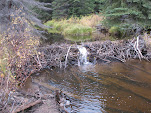
With the spread of deciduous trees there will be food and building material for beavers. With the beavers come a whole range of benefits. The people of Williams Lake, right in the heart of the pine forests, know all about this. In the 30's Their own Eric Collier began to rebuild the beaver dams by hand in the head waters of Meldrum Creek and in the 40's obtained two pair of beaver which multiplied and took over the work. The benefits both to his area and for downstream farmers were huge.

Water flowed year round in the creeks instead of mainly in spring, Animals and plants returned, trout and salmon came back to the streams, forest fires greatly decreased. Cattle had sweet water to drink instead of muddy bogs to get stuck in and die. What sort of industry could come out of such an environment.

Eco tourism. Much of the world depends on tourism to top up their GDP. With a hugely enriched environment, the interior of BC could greatly expand this part of their economy with horse trecks, photo tours hiking and so forth.

Hunting. It is likely with increased forage that ungulate populations (deer, moose etc.) will increase and with them the population of wolves, Mountain Lions and bears. Trophy hunting could play an increasing part in the economy of The Chilcotin.

Fishing. If the experience of Eric is anything to go on, the fishing will improve immeasurably when there is a large healthy population of beavers in the area. This also attracts tourism and provides recreation and food for the locals.

Maple Syrup. And how about an experimental planting of sugar maples. The weather should still be harsh enough in the Chilcotin to accommodate the life cycle of these trees. Perhaps Williams Lake could give Eastern Canada a run for their money.

Fur Trapping. Who knows if fur will ever become PC again. If so, beaver dams breed masses of muskrats which have beautiful fur. One warning, though. Leave the beavers alone. They are the goose that lays the golden egg.

Lumber. This may seem a strange suggestion since the lumber industry is disappearing. But how about investigating which trees could be planted that can be used for pulp and which other types of trees could be grown for lumber. It is long term investment but a farmer might plant a few hectares of oaks, black walnut or other prime timber, for instance, and keep them pruned as New Zealanders do with Pinus radiata to make clear wood. Oak will always command a high price and this could be a farmers retirement fund. There must be many other species of valuable trees that would prosper in the new climate of the interior of BC including varieties of nut trees. How about an experimental planting of every species of tree that could conceivably be of economic benefit in the area. Trees already planted in private gardens may already give an indication of which species prosper in the area.

There will be many other opportunities from the change that is occurring. The trick is to find them.