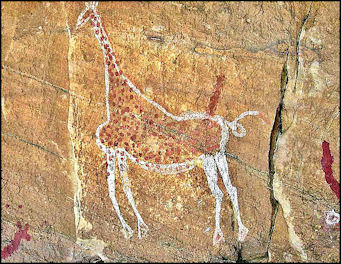
There is a fascinating possibility that the Sahara desert could be vegetated and brought back to the state it was some thousands of years ago. Paintings on cave walls and rocky overhangs shows a rich fauna of the type we only see today further south in Africa. In addition we only see very old trees of some species in the Sahara. Seeds from these trees don't germinate now due to the dry conditions. The trees put down roots during a wetter period and have followed the water table downward as the Sahara dried out.
'Greening' could be achieved if we could induce the monsoon to re-establish itself over the Sahara. Such an engineering/agricultural project may sound like pie in the sky but there are reasons to believe that it might be possible. But first, what is a Monsoon.
We are all familiar with the famous Monsoon over India but this is just one Monsoon among many. A monsoon occurs in the summer when the sun heats the land enough to cause the air above it to rise and suck in moist air from over the ocean. It helps if this air is sucked up and over rising ground and it further helps if there is some moisture in the air that is already over the land from, for instance, land vegetation transpiration. In addition, vegetated land has a lower albedo than bare sand and rock. In other words, if the land is already vegetated, a monsoon is more likely than if the land is bare. The following map shows the location of
monsoons in the world. 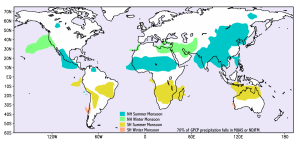
Air can only hold so much moisture and the amount is greater for warm air than for cool air. The air as it flows over up-sloping land, expands, cools (Appendix 1) and reaches the dew point which is the temperature where the air is fully saturated. Further cooling due to further increase in altitude and the air becomes super saturated and the moisture begins to condense out of the air in small droplets. Now another effect increases the rise of the air.
The phase change from water vapor to water releases a huge amount of heat. (Appendix 2). This keeps the air from cooling and makes it more buoyant with respect to the surrounding cooler air. This powers it upward to release more moisture. You begin to get those huge cumulus clouds.
You might think that the air with a suspension of tiny droplets of moisture (cloud or fog) would be heavier than the air from which it formed and you would be correct. It is just that the effect of the release of latent heat, as water vapor changes to water, is way stronger than the effect of suspended water droplets in the air.
The key to the whole system is sufficient summer heating to get the air rising in the first place and sucking air over the land from the sea.
You would think at first glance that the Sahara would be ideal. After all, it is very hot in the middle of the Sahara. Apparently it is not hot enough. In fact the Albedo (reflectivity) of the Sahara is rather high. Not as high as for snow but the light colored sand reflects a lot of the incoming radiation from the sun, back into space. In addition, with clear sky at night the heat accumulated during the day, radiates straight back into space. Here is where humans can have an effect.
Across the Sahel, the area to the immediate south of the Sahara, a number of countries have decided to plant a band of trees. This is exactly what is needed. When you have trees, the light and other wave lengths of EM radiation from the sun, hits the trees and some is changed into heat. The rest is reflected. Because of the physical form of the trees,(vertical surfaces) reflected radiation is likely to then hit another surface, either another tree or the ground. From there another surface, each time with more of the original energy changed into heat. If you look from space, a tree covered area looks dark. In other words it has a low albedo. The question is, can we plant enough trees to have a sufficient effect.
You can think of trees as a greenhouse solid (appendix 4)
Trees also have the second effect mentioned above. They transpire moisture into the air so there is more water vapor available for condensation and the release of latent heat.
Water is interesting in another context. Carbon dioxide absorbs part of the spectrum of heat that is radiated from the ground and re-radiates it in all directions including sideways and downward but it misses a portion of the infra-red spectrum. Water vapor intercepts some of these frequencies and so increases the green house effect.
If you look at the above map, you will see that a monsoon occurs to the south of the Sahara. Perhaps all we have to do is to continuously widen the band of trees toward the North and the Monsoon will follow. It might even be worth while to use precious fresh ground water or desalinated water to ensure the survival and growth of the trees as we gamble on a much greater return of water from an established monsoon. Apparently there is a huge reservoir of ground water under parts of the Sahara but is not being renewed by rainfall. We can either use this water for present agriculture until it runs out or we can use it to grow trees, gambling on the fact that we can re-establish the monsoons for a much greater return of water to the Sahara and a replenishment of the ground water.
There are other factors that likely play a part in a lack, at present, of a monsoon over the Sahara. As mentioned, at night, heat is radiated through the clear skys into space. Consider a canyon in the desert. It will have heated up during the day (although less than open sand since part of it will have been in shade during the day) and when night comes, heat will be radiated from it's surfaces. On the open desert, pretty well any direction heat is radiated is out into space. However in a canyon, much of the radiation from the bottom and sides will hit another surface and be absorbed to be re-radiated. A canyon is something of a heat trap and I'm sure desert dwellers have discovered this. A canyon would be an ideal location to hunker down for the night.
It is not unusual to find ice in the open desert in the morning in, say, a cup of liquid that you have left on the surface. This, despite the fact that the day was blistering hot and will be so again today. Basically, the desert looses all that lovely heat it accumulates over the day, during the night. You see where I am going with this.
If you have established a forest, even with trees quite spaced out, radiation from a warmed tree or from the warmed ground is likely to hit another surface with less of it being radiated out into space. In the morning, it will be warmer in a forest than in the open desert. The more heat retained, the greater the chance of a monsoon.
A forest causes more heat to be accumulated during the day and less heat to be lost at night.
The heating during the day starts from a higher temperature in the morning.
Another effect occurs if the increase in air humidity results in clouds, even thin cirrus clouds. At night, this will hold heat in by reflecting it back down to the earth, resulting in over all warming. Clouds at night are probably the major factor amongst all the above in retaining the heat during the night.
Then we have Green House Gasses. Already, the concentration of Carbon dioxide, methane, oxides of nitrogen and a few others are warming the atmosphere by absorbing heat radiation from the ground and re-radiating it in all directions. But water vapor itself is a green house gas. The following chart shows the absorption spectrum of Carbon dioxide and water vapor. Note that water vapor absorbs infra-red wave lengths that Carbon dioxide misses.

Then there is the added effect of water vapor on the buoyancy of the air. Just thinking about the weight of water compared to the weight of air, you might expect that humid air would be heavier than dry air but it is exactly the opposite. When you dissolve a salt such as sodium chloride into water, the ions of sodium and chloride fit in between the water molecules. The total volume of the solution is less than the volume of the water plus the volume of the dry salt. Gasses are not like that. Every gas you have in a mix contributes exactly it's volume to the mix. Water vapor is lighter than air so the mix will be lighter, the more water vapor that is in the air (appendix 3)
There is a technology that could help. There exists a technology to grow vegetables in tunnel houses, using water from the sea or from an underground source of alkali, or other, otherwise unusable water. Besides vegetables it results in the production of brine and fresh water. The brine must be piped back to the sea or into evaporation ponds. If the brine is evaporated, the accumulated salt is either used if it has a market value or is periodically collected up and transported to the sea. The fresh water is used to grow the vegetables. The excess fresh water flows down into the ground, creating a lens of fresh water around the tunnel house. Once there is fresh ground water, vegetation begins to develop around the tunnel house and this helps with the above mentioned second effect that promotes the formation of a monsoon. Namely the increased humidity of the air.
It is important to have a rich organic soil in the Tunnel house with some UN-oxidized carbon. Such soils scavenge and retain nutrients from the irrigation water so that pure fresh water peculates down into the ground.
Of course, once the monsoon has started, it tends to be a self reinforcing process as more and more vegetation develops naturally. It is a gamble but I think it will be worthwhile to use precious ground water or even desalinated water to establish a forest across the south of the Sahara and to continually widen it in the hope that it will result in a much greater return of fresh water from an established monsoon. It would probably take a cooperative effort by all the Northern African countries.
Something else worth mentioning is the effect of an ever warming ocean. When the ocean is warmer than the surrounding land, air rising over the ocean pulls air from the land. You have the typical evening and night off-shore wind. And the air over the ocean contains lot's of moisture so the latent heat effect can further strengthen the pull of air from the land. On the other hand, the warmer the ocean, the more moisture in the air above it. If the warming of the desert can be made sufficiently strong to overcome the pull from the sea, there is more water vapor available for a monsoon.
One sad but inevitable effect of the success of this action would be on the Amazon Jungle. A jungle, left alone, is very good at recycling it's nutrients. It appears incredibly rich, just like a coral reef but this is an illusion. At present, the Amazon receives a small but much needed dose of additional nutrients from the dust blowing off the Sahara. If the Sahara is 'greened' that will stop. The Amazon will cease to be 'the lungs of the world' and will stop sucking up carbon dioxide. However, it looks like the Amazon is finished anyway due to man's activity. The Sahara would likely take on the roll of the Amazon if the Monsoon was re-established.
Appendix 1
When air expands it cools. The amount of water vapor air can hold depends on it's temperature. Pressure decreases with altitude so a body of air blowing upwards over a mountain range, for instance, expands, cools and is capable of holding less and less water. If it has been saturated by blowing over an ocean, it will be super saturated as soon as it begins to rise over land and will give up it's water as precipitation.
Appendix 2
It takes a massive amount of heat to evaporate water. When water vapor condenses, it releases this same amount of energy. I'll use calories to explain this since in this one instance, it is easier to understand than using the modern SI units. A calorie, (small 'c')* by definition is the amount of heat needed to raise one gram of water by one degree centigrade. Thus to raise a gram of water at zero degrees to the boiling point at 100 degrees, it would take 100 calories. To evaporate this same gram of water would take 540 calories. In other words, enough heat to raise the temperature of that gram of water from freezing to boiling 5 times and then from zero to 40 degrees. This heat is given off when water vapor condenses into water.
* A large Calorie (Capital C) is defined as the amount of heat needed to raise one kilogram of water by one degree centigrade.
Appendix 3
The molecular weight of air is an weighted average between Nitrogen (28) and Oxygen (32) so, to a first approximation, is about 30. The molecular weight of Water is 16 for Oxygen and 1 + 1 = 2 for Hydrogen. So water vapor is 18/30 x 100 = 60% as heavy as air. The more moisture in air the lighter it is.
Appendix 4
Green house gasses keep the earth warm. When the radiation from the sun hits surfaces, it warms them. They then radiate longer wave lengths of EM radiation. Green house gasses absorb specific wave lengths of this longer wave length energy and radiate it in all directions. So the effect of green house gasses is to retain heat in the air. Trees do the same. They absorb radiation and re-radiate it in all directions. A forest intercepts much of this radiation and re-radiates it in all directions. You can think of a forest as a green house solid.