Total Pageviews

Tuesday, January 18, 2022

Deep Sea Nodule Mining


There are many areas in the deep deep ocean where the bottom is covered with mineral nodules. Some of the minerals in the nodules are ones that we need for the transition away from fossil fuels.  Ways are being developed to mine these minerals. 
 
Sept 2022. - Note that a new type of battery has been developed using no Co or Ni and using a Li, Fe P04, Mn chemistry.  It is reported to be  superior to other Li batteries  in terms of its longevity and safety.  Ocean bottom nodules are rich in Mn, Co, Cu, Ti and Ni and have high concentrations of Fe.  Some of them also contain Rare Earth Minerals.  Personally, I would sacrifice a little energy density in my EV battery for an increase in the longevity of the battery.  This latest version of a Li battery can be fully charged and  discharged with no added fade and if  not in use for long periods of time must be periodically charged.  50% is ideal for storage.
 
Note also that recycling technology for batteries is getting better and better.  This will eventually decrease the need for new mining.  However at present a lot of newly mined minerals are needed.
 
So far, the method of choice seems to be to lower a crawler down to the sea bottom that breaks the nodules into smaller pieces which are then sucked to the surface.  Along with the nodules comes quite a bit of bottom-water* and non-nodule particulates including burrowing organisms in the sediment.  The crawlers raise plumes of this particulate material which can settle over un-mined areas and smother the organisms there.  It consists of a little mineral matter and of the 'organic snow' that has accumulated over the eons. 
 *Which turns out to be potentially quite important
 
We seem to be conflating* deep sea nodule mining with bottom trawling.  They are quite different.  As is often the case, the devil is in the detail.  How you do something is often more important than the fact that you are doing it.
*Conflate - modern use "confusing one thing for another, whether they be similar or not"
 
 With bottom trawling for fish, clams and prawns, the same area is dragged again and again, never allowing the bottom fauna to recover.  In addition every square centimeter is dragged, eliminating untouched areas  that could re-colonize the dragged areas.
 
 With deep sea mining, the area can only be mined once.  When an area has been mined it will be many, many thousand, even millions of years before nodules will be found there in sufficient concentrations to mine again.  (And with our ever increasing output of green house gasses, year by year, we may well not be around then)

But as I said at the outset, the devil is in the detail.  For instance:
 
     We can legislate and enforce, that only a defined percent of the sea bed can be mined.  The nodule rich areas are so vast that this should not be a problem.  Companies that are not complying loose their license to mine.  This way, untouched areas can be left to re-colonize the mined areas.  Possibly even better, we could mine alternate strips.
 
     We must design the crawlers so that the dust they raise on the sea bed is confined and sucked to the surface.  This is to avoid smothering adjacent un-mined areas.  If this material is discharged at the surface it will be dispersed far and wide by currents which go different directions at various depths and will be diluted.  By the time this fine material reaches the bottom, if it ever does#, it should be very little more than the background level of sedimentation.    As an added measure we could  spray the bottom water over the surface of the ocean to start the dispersion*.
# Passive filter feeders in the photic zone will likely take up this source of organic material. The population of such filter feeders will increase in an area where this new source of  material is available.  This would likely form the foundation for a food web.
*Bottom water will be denser than surface water so if released in a solid stream, will likely plunge downward.  Spraying it on the surface will facilitate the mixing with surface water in the photic  zone, allowing time for filter feeders to take up the particulate material and for phytoplankton to utilize dissolved nutrients in the bottom water.  The ocean surface above areas with nodules tend to be ocean deserts with respect to nutrients.  A nodule mining operation will likely  become a biological oasis in this desert.
 
And there may be a couple of benefits on the sea floor:
 
     A climax ecology is somewhat boring.  A certain level of disruption (a tree falls in the jungle) increases biodiversity by allowing pioneer species to  flourish.  Mined-out areas, as long as they are limited in terms of the percent of an area that is mined, are ripe for colonization by pioneer species followed by a sequence, that eventually leads back to a climax ecology.  The question is not whether to mine or not mine but rather what percent to mine and how much to leave.
 
     Bottom water, (as is well known from areas where natural up-welling occurs), powers massive productivity.  A good example is the area off the coast of Peru where up-welling occurs during the la-Nina and El-Nino-neutral years.  It is one of the most productive areas of ocean in the world.   If bottom water, from nodule mining, discharged into the photic zone with its dissolved nutrients and fine organic dust it will likely have the same effect as a fecal plume from a whale.  As mentioned, the discharge water could be sprayed across the surface of the ocean to begin the mixing and to avoid having this water plunge back down into the abyss. 
 
As I said at the outset, the devil is in the detail.  Instead of thinking 'bottom trawling' when we hear 'nodule mining' we should look at the detail and the opportunities and ways of benefiting from the nodule mining.  It would likely be  too expensive to pump water and sediment from the deep ocean just to stimulate a plankton bloom in mid ocean deserts and to reap the  benefits that would follow from this.  It is a different story if we can catch a ride on a commercial operation that gets its finance from the sale of nodules and as a by-product, creates an oasis in the ocean desert.

I would think that an initial experiment would be to suck up bottom water with the fine particulate material from the abyss and spray it on to the surface of the ocean for  a couple of months to see what develops.  This should be done from a surface ship that can maintain its geographical position.  The surface of the ocean is always moving so the surface water will be flowing past a stationary ship.  The bottom material will not be discharged into the same water but into a moving stream.  Samples should then be taken along the discharge stream to see what develops. I bet it will be a succession starting with phytoplankton and small filter feeders and ending with fish and even marine mammals.

Note:  I just learned from this video that the bottom is rich in worms which cycle the snow of organic material which is constantly falling through the water and these worms form the bases of a rich food web.  They would likely be sucked up along with the nutrient rich deep ocean water.  On one hand, it is important that we have a mining system that mines alternate strips, leaving strips untouched.  On the other hand, this rich source of food, sucked up to the surface will soon be utilized by surface marine life in what is at present a marine desert in terms of available food.  Island countries in the Pacific could find a rich surface fisheries resulting from the mining of these nodules which develops downstream from the surface ship.  It is vital that the 'hurricane' of  dust they raise is confined and sucked to the surface and not allowed to smother the un-mined strips.


Friday, October 22, 2021

Making pyrolysis economic

Pyrolysis, the anaerobic heating of hydrocarbons such as wood, old tires, used engine oil, plastics, tallow and so forth, needs to be economic for it to be undertaken. Below are some suggested ways to increase the financial feasibility of pyrolysis.


 Energy conservation

Pyrolysis needs heat energy to cause the various long chain materials to break ('crack', in petrol-chemistry terms)  and the applied heat must be at a temperature of about 5000C. But, of course you don't want to be heating the great outdoors.  That is a waste of energy/money.  Super insulation is needed so that you only use  the amount of energy needed to break the bonds. An insulation material that comes to mind is the Aerogel that was used to protect the shuttles during re-entry but cost and availability might be a barrier.


Source of energy

Clearly the energy to heat the retort must be renewable.  Energy must come from hydro, wind, geothermal or solar sources.  Renewable energy continues to go down in price as the hardware to produce it becomes less expensive. There are a couple of possibilities.  With the spot-price-silliness that we have in New Zealand, electric energy is very cheap when it is in excess.  Either the pyrolysis unit can operate, only when energy is cheap or cheap energy can be bought and stored in a mega battery to ensure the continual operation of the pyrolysis unit.  


It may be worthwhile for the pyrolysis unit to own it's own renewable energy kit and thus be always paying the wholesale price.  This 'kit' continues to decrease in price.  With a battery as well, excess energy can be sent to the grid when spot prices are high. 


Energy is likely to be one of the largest running costs in a pyrolysis factory.  


Externalities

Many  waste streams  can be pyrolyzed to produce either liquid fuels or easily compressed and liquefied fuels.  Many waste streams are problematic if not disposed of somehow.   

There is now a cost to send waste to land fill and a land fill trashes beautiful pristine wild areas which are then no longer an asset to the community.  

Some wastes are direct health hazards such as the leaching of material from them into the ground water or as breeding grounds for mosquitoes (tires).  As the world warms, tropical mosquitoes that carry a range of very nasty diseases will be moving poleward.   

Many pyrolyzable wastes are a fire hazard and the by product of  burning some of them creates the toxic, carcinogenic, dioxane, and fine particulate material.  If they are sent overseas, the receiving country may simply dump them into the ocean.  There is no need to describe why ocean dumping is problematic.


The point is that the pyrolysis unit has to be credited for the financial cost it mitigates when a solution is not found for that particular waste and/or for the present cost of taking care of the waste.   Government action may well be necessary to ensure this.


By products

Depending on the feed stock, there are various valuable by products of pyrolysis.


Wood

The by product of wood-pyrolysis is charcoal.  Charcoal can be bagged and sold for barbecues or can be incorporated into agricultural soils, earning carbon credits.  See Terra Preta


Plastic (clean or contaminated)

No by products result from the pyrolysis of plastic.  It all converts back into alkenes and alkanes.  The alkenes can be converted into the more useful alkanes by saturating the double bonds with green hydrogen.  Petro-chemical engineers have methods of either bonding low molecular weight fractions into larger molecules or, on the contrary, cracking long molecules into smaller ones to get more of the desired fraction.


Electronic equipment

The pyrolysis of electronic equipment results in a metal rich ash.  As battery recycling ramps up, this ash could likely be sent to a battery recycling facility for the separation and recovery of these metals.  This sort of ash is a far richer source of metals than any natural ore although it is a rather challenging mix.  At present, waste circuit boards are sent overseas for the recovery of their metals.  Most of the weight of a circuit board is plastic.  With pyrolysis, you don't send the plastic  saving on weight and hence expense.


Used tires

By products of the pyrolysis of tires are iron, sulfur and carbon black.  Sulfur can be converted into sulfuric acid, using the oxygen which is a by product of the Hydrogen which has been produced for saturating alkenes.  Sulfuric acid is a very valuable product used in a plethora of chemical processes.  Carbon black is used in air and liquid filters, black paint and in the production of new tires and black plastic.  The iron is sent to an iron refinery where it is combined with iron ore in the smelting process.


Used engine oil

Used engine oils are very variable.  For instance some of them have additives of materials such as molybdenum sulfide.  Presumably this, and any other similar materials would remain after the pyrolysis of used engine oil.  In addition, there may be a small concentration of metal from the engines.  But I suspect that well north of  99% of engine oil should convert into the usual pyrolysis products.  The ash could probably be combined with the ash from electronic equipment and sent to a battery recycling facility.


Tallow

Tallow should not have any by products and rendering is not necessary.  It can be directly pyrolyzed.  However, if tallow is converted into biodiesel  instead of using pyrolysis, glycerine is a by product.  One has to work out if it is worth while to build a separate facility for the chemical conversion of tallow to diesel or to simply pyrolyze this waste stream.


Side economic benefit

If this whole process is kept in the eye of the public as it proceeds, it would seem likely that the petrol company responsible would gain a greater share of an ever diminishing market for petroleum products.  Parts of the output of pyrolysis can be mixed into conventional petrol and diesel, making them 'greener' and done through already existing distribution channels.

Friday, September 3, 2021

Petrol station conversions


The demand for petroleum products (LPG, Gasoline, Diesel and lubricating oil) is not going to suddenly stop.  Second hand ICE (Internal Combustion Engine) cars are going to be around for a long time and they will become very very cheap as the demand  for them wanes.  Everyone will want an electric car but the cheapness of ICE cars will persuade many to continue to use them.   And there will always be "petrol heads" who just love their ICE cars.


However, the demand for petroleum products will start to decrease and it will be a one way trend.  What do "gas stations" do.  They work on very small margins and large volumes and on having a monopoly on the fuel we need for transportation.  It doesn't take much of a decrease in their sales to make them a stranded asset.


Clearly, if they want to continue in business, they have to become energy providers rather than petroleum providers and allow us to charge our battery cars at their facilities.  They have a problem here that all sorts of other companies have realized that if they have a charging station, it will attract customers to their premises to shop while the car is being charged.  Charging stations are springing up at super markets, restaurants and other businesses. 


The petrol companies need other streams of revenue.  A couple come to mind.  Already many 'gas stations' have stores and restaurants connected to their petroleum outlets and I suspect that they make more money on these than on the sale of petroleum.  Just here where I live, one gas station showed real initiative when it started to sell really large ice cream cones at cost.  Suddenly their business boomed and the kids pushed Dad into stopping there to fill up.


When you are charging your car, no matter how fast 'fast charging' gets, it will always take more time than to fill up the tank of an ICE car so you have a little time on your hands.  It is likely that smart gas stations will expand the goods that can be purchased at their stations.


But there is another revenue stream that could be attractive to a petrol station that is also a charging station.  Mega Batteries.


If a lot of cars are charging at the same time, especially if they are all fast chargers as seems to be the trend now, it will put a huge demand on the grid.  The whole grid will have to be upgraded to avoid burning out the wires at peak times.  that is unless the petrol stations install a mega battery.


Let's say for the sake of the argument a petrol station installs a one mWh (mega Watt hour) battery.  A typical car of the future will have, say, a 100kWh battery.  A fully charged 1mWh battery could therefore charge up 10 cars without needing recharging.  Batteries are now being developed based on Li that will be able to charge right to the top and be used right to the bottom without damage.  Anyway,why such a large battery, Isn't it a waste putting in such a large capacity you might say.


Well no.  Mega batteries by themselves are ridiculously profitable.  Look at the Hornsdale example.  It is rumored to have paid off its $66m(Aus) cost in three short years by buying power when it is cheap and selling it when it is expensive.  Better still, for the Hornsdale site, it is part of a wind farm so they  store power when it is being generated in excess of demand rather than having to feather the wind turbines.


This points up the next profit generator for the gas stations we are converting.  They should install solar panels on every surface they have available.  Most of them have a large roof over their petrol pumps and the roof of the adjacent building where they sell pies, ice cream, bread and milk. 


A petrol company with many gas stations could become a major player in the energy supply of a country.  One of our NZ petrol companies has upward of 250 stations.  With a one mWh battery at each station, they become one of the largest battery operators in the world and as a bonus it is distributed storage.  They become a large peaker plant and benefit from our insane spot price system.


There is also a possibility that negotiations with existing power distributors might result in less expensive power to charge the mega battery since the power distributor avoids the need to upgrade their grid to cater for a whole bunch of fast chargers all operating at the same time. The only really grunty cables that are needed are those from the mega battery to the charging points, not the whole grid.


And here is one more revenue stream generator.  As ICE cars age, there is, going to be, for a while, an ever increasing demand for mechanics.  The cars will be getting longer and longer in the tooth and need ever increasing maintenance.  For a while, a connected garage, the way it used to be, will be a real money spinner.  Mind you, at some point this will fade as electric cars take over.  The smart operator will make money in this golden period and then get out of this part of the business.


It is going to be a difficult time for 'gas stations' unless they innovate and become energy stations.

Thursday, August 5, 2021

Open letter to NZ power companies.


        An open letter to NZ power companies
 
Just curious.  A rhetorical question, if you like.  Why is it that none of the power companies and none of the wind farms have installed mega batteries.  The 100mWh Tesla battery at Hornsdale in Southern Australia has paid off it's total capital costs in 3 short years.  I've never heard of such a profitable investment.  Now virtually all the income is pure profit.  In addition it has greatly stabilized the voltage and frequency of the grid it is part of and has reduced power prices.  They are now installing more batteries, more or less doubling their capacity.

For new wind farms, I wonder why they don't put in a mega-battery first before they even have the first wind turbine up and running.  With our crazy spot price system, it would seem likely  that they would have started to make a profit right off, buying low and selling high.  When the turbines are working, they can, of course, store any excess power they generate instead of having to feather the the turbines.  Mega batteries basically constitute a peaker plant*.
*A power plant that is only used when power demand is unusually high.  They are highly uneconomical but are needed to ensure a constant supply of electricity regardless of the demand.

From the customer's point of view, if power companies had mega batteries, the power companies could stop being so twitchy about their customers installing solar panels.  They could give the customer a decent price for the power that he sends to the grid, say 75% of the price that they charge the customer for power he takes from the grid.  This would eliminate the need and the motivation for the customer to go off grid and/or install his own batteries.  The customer foots the capital cost for the generation infrastructure (panels) and the power company gains all this extra generation capacity for free.  It is a win win all around.

 Lithium is not the only game in town.  For instance, there are the ZnBr plating batteries and the liquid metal batteries using Ca and Sb.  Both have the distinct advantage of not degrading over time and both can be fully charged and discharged without damage.   They also don't lose their charge if left fully charged.  They don't have quite the cycle efficiency of Li batteries but are a tad better than pumped storage. If you go to youtube and type in 'Just Have A Think Iron Batteries' you will see another innovation that, if it is all it is cracked up to be, will revolutionize renewable energy.  Then there are a range of redox batteries using the different oxidation states of Fe or V.

Why are you power companies so slow off the mark. You could be creaming the profits while at the same time serving your customers, something that is somewhat lacking at present.  I think I know what the answer is.

You are making lovely wind falls when the spot price peaks.  When enough mega-battery capacity is installed there will no longer be these wind falls.  Mind you the first adopters will really cream the profits.


Saturday, May 8, 2021

Greening the Sahara Desert

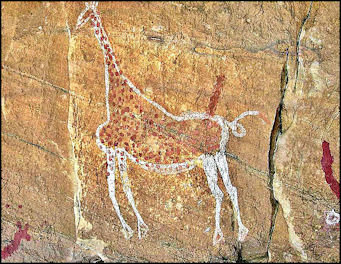
There is a fascinating possibility that the Sahara desert could be vegetated and brought back to the state it was some thousands of years ago.  Paintings on cave walls and rocky overhangs shows a rich fauna of the type we only see today further south in Africa.  In addition we only see very old trees of some species in the Sahara.  Seeds from these trees don't germinate now due to the dry conditions.  The trees put down roots during a wetter period and have followed the water table downward as the Sahara dried out.

20120206-Tadrart_Acacus_1234.jpg

  'Greening' could be achieved if we could induce the monsoon to re-establish itself over the Sahara.  Such an engineering/agricultural project may sound like pie in the sky but there are reasons to believe that it might be possible.  But first, what is a Monsoon.


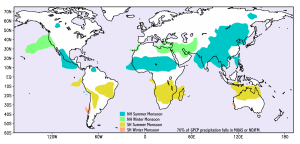
We are all familiar with the famous Monsoon over India but this is just one Monsoon among many.  A monsoon occurs in the summer when the sun heats the land enough to cause the air above it to rise and suck in moist air from over the ocean.  It helps if this air is sucked up and over rising ground and it further helps if there is some moisture in the air that is already over the land from, for instance, land vegetation transpiration. In addition, vegetated land has a lower albedo than bare sand and rock.  In other words, if the land is already vegetated, a monsoon is more likely than if the land is bare.  The following map shows the location of 

monsoons in the world. What are monsoons? – UMBRELLA

Air can only hold so much moisture and the amount is greater for warm air than for cool air.  The air as it flows over up-sloping land, expands, cools (Appendix 1) and reaches the dew point which is the temperature where the air is fully saturated.  Further cooling due to further increase in altitude and the air becomes super saturated and the moisture begins to condense out of the air in small droplets.  Now another effect increases the rise of the air.


The phase change from water vapor to water releases a huge amount of heat.  (Appendix 2).  This keeps the air from cooling and makes it more buoyant with respect to the surrounding cooler air.  This powers it upward to release more moisture.  You begin to get those huge cumulus clouds.


You might think that the air with a suspension of tiny droplets of moisture (cloud or fog) would be heavier than the air from which it formed and you would be correct.  It is just that the effect of the release of latent heat, as water vapor changes to water, is way stronger than the effect of suspended water droplets in the air.


The key to the whole system is sufficient summer heating to get the air rising in the first place and sucking air over the land from the sea.


You would think at first glance that the Sahara would be ideal.  After all, it is very hot in the middle of the Sahara.  Apparently it is not hot enough.  In fact the Albedo (reflectivity)  of the Sahara is rather high.  Not as high as for snow but the light colored sand reflects a lot of the incoming radiation from the sun, back into space.  In addition, with clear sky at night the heat accumulated during the day, radiates straight back into space.  Here is where humans can have an effect.


Across the Sahel, the area to the immediate south of the Sahara, a number of countries have decided to plant a band of trees.  This is exactly what is needed.  When you have trees, the light and other wave lengths of EM radiation from the sun, hits the trees and some is changed into heat.  The rest is reflected.  Because of the physical form of the trees,(vertical surfaces) reflected radiation is likely to then hit another surface, either another tree or the ground.  From there another surface, each time with more of the original energy changed into heat.    If you look from space, a tree covered area looks dark.  In other words it has a low albedo.  The question is, can we plant enough trees to have a sufficient effect.


You can think of trees as a greenhouse solid (appendix 4)


Trees also have the second effect mentioned above.  They transpire moisture into the air so there is more water vapor available for condensation and the release of latent heat. 

Water is interesting in another context.  Carbon dioxide absorbs part of the spectrum of heat that is radiated from the ground and re-radiates it in all directions including sideways and downward but it misses a portion of the infra-red spectrum.  Water vapor intercepts some of these frequencies and so increases the green house effect.


If you look at the above map, you will see that a monsoon occurs to the south of the Sahara.  Perhaps all we have to do is to continuously widen the band of trees toward the North and the Monsoon will follow.  It might even be worth while to use precious fresh ground water or desalinated water to ensure the survival and growth of the trees as we gamble on a much greater return of water from an established monsoon.  Apparently there is a huge reservoir of ground water under parts of the Sahara but is not being renewed by rainfall.  We can either use this water for present agriculture until it runs out or we can use it to grow trees, gambling on the fact that we can re-establish the monsoons for a much greater return of water to the Sahara and a replenishment of the ground water.


There are other factors that likely play a part in a lack, at present, of a monsoon over the Sahara.  As mentioned, at night, heat is radiated through the clear skys into space.  Consider a canyon in the desert.  It will have heated up during the day (although less than open sand since part of it will have been in shade during the day) and when night comes, heat will be radiated from it's surfaces.  On the open desert, pretty well any direction heat is radiated is out into space.  However in a canyon, much of the radiation from the bottom and sides will hit another surface and be absorbed to be re-radiated.  A canyon is something of a heat trap and I'm sure desert dwellers have discovered this. A canyon would be an ideal location to hunker down for the night.


It is not unusual to find ice in the open desert in the morning in, say, a cup of liquid that you have left on the surface.  This, despite the fact that the day was blistering hot and will be so again today.  Basically, the desert looses all that lovely heat it accumulates over the day, during the night.  You see where I am going with this.

If you have established a forest, even with trees quite spaced out, radiation from a warmed tree or from the warmed ground is likely to hit another surface with less of it being radiated out into space.  In the morning, it will be warmer in a forest than in the open desert.  The more heat retained, the greater the chance of a monsoon. 


A forest causes more heat to be accumulated during the day and less heat to be lost at night.

The heating during the day starts from a higher temperature in the morning. 


Another  effect occurs if the increase in air humidity results in clouds, even thin cirrus clouds.  At night, this will hold heat in by reflecting it back down to the earth, resulting in over all warming. Clouds at night are probably the major factor amongst all the above in retaining the heat during the night.


Then we have Green House Gasses.  Already, the concentration of Carbon dioxide, methane, oxides of nitrogen and a few others are warming the atmosphere by absorbing heat radiation from the ground and re-radiating it in all directions.  But water vapor itself is a green house gas. The following chart shows the absorption spectrum of Carbon dioxide and water vapor.  Note that water vapor absorbs infra-red wave lengths that Carbon dioxide misses.

Climate Science Investigations South Florida - Energy: The Driver of Climate

 Then there is the added effect of water vapor on the buoyancy of the air.  Just thinking about the weight of water compared to the weight of air, you might expect that humid air would be heavier than dry air but it is exactly the opposite.  When you dissolve a salt such as sodium chloride into water, the ions of sodium and chloride fit in between the water molecules.  The total volume of the solution is less than the volume of the water plus the volume of the dry salt.  Gasses are not like that.  Every gas you have in a mix contributes exactly it's volume to the mix.  Water vapor is lighter than air so the mix will be lighter, the more water vapor that is in the air (appendix 3)


There is a technology that could help.  There exists a technology to grow vegetables in tunnel houses, using water from the sea or from an underground source of alkali, or other, otherwise unusable water. Besides vegetables it results in the production of brine and fresh water.  The brine must be piped back to the sea or  into evaporation ponds.  If the brine is evaporated, the accumulated salt is either used if it has a market value or is periodically collected up and transported to the sea.  The fresh water is used to grow the vegetables.  The excess fresh water flows down into the ground, creating a lens of fresh water around the tunnel house.  Once there is fresh ground water, vegetation begins to develop around the tunnel house and this helps with the above mentioned second effect that promotes the formation of a monsoon. Namely the increased humidity of the air.


It is important to have a rich organic soil in the Tunnel house with some UN-oxidized carbon.  Such soils scavenge and retain nutrients from the irrigation water so that pure fresh water peculates down into the ground.


Of course, once the monsoon has started, it tends to be a self reinforcing process as more and more vegetation develops naturally.  It is a gamble but I think it will be worthwhile to use precious ground water or even desalinated water to establish a forest across the south of the Sahara and to continually widen it in the hope that it will result in a much greater return of fresh water from an established monsoon.  It would probably take a cooperative effort by all the Northern African countries.


Something else worth mentioning is the effect of an ever warming ocean.  When the ocean is warmer than the surrounding land, air rising over the ocean pulls air from the land.  You have the typical evening and night off-shore wind.  And the air over the ocean contains lot's of moisture so the latent heat effect can further strengthen the pull of air from the land.  On the other hand, the warmer the ocean, the more moisture in the air above it.  If the warming of the desert can be made sufficiently strong to overcome the pull from the sea, there is more water vapor available for a monsoon.


One sad but inevitable effect of the success of this action would be on the Amazon Jungle.  A jungle, left alone, is very good at recycling it's nutrients.  It appears incredibly rich, just like a coral reef but this is an illusion.  At present, the Amazon receives a small but much needed dose of additional nutrients from the dust blowing off the Sahara.  If the Sahara is 'greened' that will stop.  The Amazon will cease to be 'the lungs of the world' and will stop sucking up carbon dioxide.  However, it looks like the Amazon is finished anyway due to man's activity.  The Sahara would likely take on the roll of the Amazon if the Monsoon was re-established.


Appendix 1

When air expands it cools.  The amount of water vapor air can hold depends on it's temperature.  Pressure decreases with altitude so a body of air blowing upwards over a mountain range, for instance, expands, cools and is capable of holding less and less water.  If it has been saturated by blowing over an ocean, it will be super saturated as soon as it begins to rise over land and will give up it's water as precipitation.


Appendix 2

It takes a massive amount of heat to evaporate water.  When water vapor condenses, it releases this same amount of energy.  I'll use calories to explain this since in this one instance, it is easier to understand than using the modern SI units.  A calorie, (small 'c')* by definition is the amount of heat needed to raise one gram of water by one degree centigrade.  Thus to raise a gram of water at zero degrees to the boiling point at 100 degrees, it would take 100 calories.  To evaporate this same gram of water would take 540 calories.  In other words, enough heat to raise the temperature of that gram of water from freezing to boiling 5 times and then from zero to 40 degrees.  This heat is given off when water vapor condenses into water.

*  A large Calorie (Capital C) is defined as the amount of heat needed to raise one kilogram of water by one degree centigrade.


Appendix 3

The molecular weight of air is an weighted average between Nitrogen (28) and Oxygen (32) so, to a first approximation, is about 30.  The molecular weight of Water is 16 for Oxygen and 1 + 1 = 2 for Hydrogen.  So water vapor is 18/30 x 100 = 60% as heavy as air.  The more moisture in air the lighter it is.


Appendix 4

Green house gasses keep the earth warm.  When the radiation from the sun hits surfaces, it warms them.  They then radiate longer wave lengths of EM radiation.  Green house gasses absorb specific wave lengths of this longer wave length energy and radiate it in all directions.  So the effect of green house gasses is to retain heat in the air.  Trees do the same.  They absorb radiation and re-radiate it in all directions.  A forest intercepts much of this radiation and re-radiates it in all directions.  You can think of a forest as a green house solid.