Total Pageviews

Friday, January 1, 2016

The Greenhouse Effect

Much has been written about the green house effect without really explaining what it is and how it works.  I thought I would chip in my two cents worth and hopefully make it make more sense.  I'll start with the Sun which has the mother of all green house effects.  I'll use the sun because it is pure physics with no emotion involved.  Then, when we are in the proper scientific mind set we can look at the earth.

So,,,, the sun started out as a cloud of elements with by far the greatest part being hydrogen.  It collapsed under its own gravity and if you have ever pumped up a bicycle tire, you know that the end where the hose is, warms up.  A diesel engine works on the same principle.  You compress the charge of air about 20 times and it becomes so hot that when you spray in the mist of diesel oil, the oil ignites.  Of course, with a cloud of gas heavy enough to produce the sun, the compression was far greater and the hydrogen at the middle was very hot and very compressed.  It was so hot and so compressed that the hydrogen atoms began to fuse together and produce Helium, releasing large quantities of energy as photons (electromagnetic energy).

This heated up the nearby hydrogen which was hot enough to fuse but not compressed enough.  What is interesting  is that very hot hydrogen absorbs and re-emits the photons (light) produced by the nuclear furnace.  And it re-emits them  in all directions.  Some are sent back toward the core, some sideways and some toward the surface.  All are again and again absorbed, emitted, absorbed, and emitted, over and over again.  There are various estimates  for the time it takes  the energy of a photon to reach the surface of the sun but all are in the thousands of years.

Compare this to what the situation would be if each photon created in the center of the sun was not absorbed by the overlying hydrogen.  As quickly as the energy was produced it would travel through the overlying hydrogen and leave the sun.  Remember that it only takes 8 minutes for the energy of the sun to reach us once it has reached the surface and we are 93 million miles from the sun.  Instead of staying in the sun, the energy would leave the sun in about 1/2 X 8minutes / 93 X 60 = about three seconds.  The sun would cool down and probably the thermo-nuclear reaction at the center would stop.

This is the green house effect. On the Earth, the atmosphere is transparent to most* of the light energy coming from the sun so the atmosphere is heated from below as this radiation is absorbed by the earth.  The warmed earth radiates long wave radiation.   If this long wave (infra-red) energy was radiated at the speed of light straight back into space, the planet would cool rapidly.  If on the other hand, some of the gases in the atmosphere absorb and re-emit the energy coming from the planetary surface in all directions, the planet warms up. It is a fact of nature that the wave lengths of energy coming off the earth, mainly in the infra red spectrum is absorbed and re-emitted by the gases we call green house gases.  They include water vapor, methane, nitrous oxide and a bunch of others in addition to Carbon dioxide.

*Some short wave lengths are absorbed in the upper atmosphere

On earth we have the same phenomenon as on the sun but vastly reduced.  Green House gases in the atmosphere  absorb photons in the infra-red part of the spectrum and re-emit them in every direction.  More of these molecules then do the same.  This delays the escape of heat from the atmosphere and causes it to warm.  The greater the proportion of green house gases in the atmosphere, the longer it takes for the energy coming off the earth to reach space and head out at the speed of light.

As the earth (or any body)  warms up, it radiates more energy.  Eventually we reach equilibrium with the same amount of energy being radiated as is being absorbed but the Earth is now warmer.

Sunday, December 27, 2015

How to get the beaver back

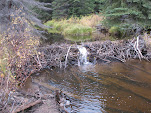
OK, so you have finally realized that at least a partial solution to your water problems is to get the beaver back in every stream or seep where he can possibly build a dam.  As you have realized, this will shift water from winter to summer (just as snow packs and glaciers used to do), recharge your water table, clean your water of sediment and nutrients, extend the life and effectiveness of your hydro-electric dams, allow these dams to provide more water and more electricity than they are doing now, greatly reduce flood peaks and so forth and so on.  So how do you get the beaver back in your catchments.

First, beavers need trees to build their dams.  Willows are first choice but any deciduous tree will do.  If you have such areas, capture and transfer some beavers to the area.  release them in lakes, artificially dammed ponds in streams or naturally deep parts of the stream. This will keep them happy as they explore the area and find a suitable location to build dams.  However, the problem is, that much of the catchment will have been degraded and will be lacking a riparian zone of trees. Let's fix that and spend very little money doing it.


Tools you will need are a chain saw (If you don't like the noise, get an electric one that plugs directly into your specially installed alternator on your pick up truck) a pair of pruning sheers, a lopper (optional), an axe, a sledge hammer and 5 foot  steel bar sharpened on one end for each member of the crew.

Find a suitable deciduous tree such as a willow, poplar, aspen, cotton wood etc. Cut it down about waste height.  You want to leave a stump to coppice (grow from the stump).  Cut the entire tree all the way from the trunk to the small twigs into fore-arm length pieces.  The pruning sheers will come in handy for the smallest branches.

The larger logs you can leave as-is or split into four.  Sharpen the bottom end of all the larger pieces with your axe.  The thinner branches don't need sharpening.  Bundle all this into your pick up truck, cover with some wet sacks and head for your site.  You must do this when there is some moisture in the soil where you want to establish a beaver friendly riparian* zone.  This might be following a rain which has zoomed down to the sea, taking your top soil with it.  Nothing like watching your top soil disappear to inspire action.

*A  zone of trees and bushes on the side of a stream or river.

At the site, take the sharpened logs and quarter logs and pound them into the ground with your sledge hammer.  For the smaller branches, use your steel bar to punch a hole into the ground.  Try to make the hole about a third as deep as the length of your pieces of branch.  Drop in the branch and heel in.

For the intermediate diameter branches, if the ground is too hard to pound them in, the bar is also useful.  Punch a hole with your bar by ramming it a few times into the same hole,  rotating the top around to widen the hole at each punch.  It is now much easier to pound the medium diameter pieces into the ground.

If you have deer around the place and no wolves to keep them moving, you will have to find some way to keep them off of your new forest at least until it has a couple of years to grow.  Many of the deciduous trees grow at phenomenal rates if protected and soon will be too high for the dear to destroy.

Have fun and make sure to take 'before' and 'after' pictures and maybe write a blog with an article for each site you do.

And what happens if your introduced beavers threaten to flood your house or wash away a road.  Simple. You install a beaver deceiver.   Look them up on the net.  Here is how you make and install one model.
 Beaver Conflict Resolution - Clark Fork Coalition


At a convenient place on the dam, remove branches.  Make a depression deep enough so that if the water only gets to that level, it won't cause damage to whatever you are trying to protect.

Get a piece of that corrugated plastic pipe and lay it over the dam.  It must be long enough to reach the bottom of the pond and  to reach he outside of the dam at the height you want the water not to exceed.

Make up a U of scrap wood and pound it down into the beaver dam, upside down to hold the pipe in place.  The beavers will come and patch up the leak that evening and you don't want them to accidentally shift the pipe.

And the last step. Get some wire weld mesh of the type they use to reinforce concrete.  The bigger the holes the better but not large enough to let an adult beaver through.  Bend this mesh in a circle to make a cylinder and attach the ends together.  On one end, clip out a couple of cross ties all around.  A bolt cutter will do nicely.  You are going to pound this cylinder into the bottom of the pond with the clipped end down and removing the cross ties will allow you to push or pound the cylinder into the bottom of the pond.  The cylinder can extend above the level of the water or you could even put a top on it of mesh* and have it totally under water.  You, of course, are going to place this cylinder over the inner end of the pipe (almost forgot to mention that).


Now no matter what the beavers do, the water will remain at the level you have determined.

* Unprotected steel which is always immersed in water corrodes (rusts) very very slowly so putting a mesh lid on the cylinder and making sure it is completely submersed is not a bad idea.  Besides if you are in an area where the water freezes in the winter, if the top of the cylinder is below the bottom of the ice, it won't be shifted by ice movement.  A bit more work but worth the effort.  Iron corrodes most quickly just at the surface of the water.

Friday, October 9, 2015

The Chernoble Nature Reserve

Much surprise is exhibited by people when they realize that the no-go area around Chernobyl is turning into a wild life sanctuary.  We see such comments as "People are worse than nuclear fall out", referring to  the ever increasing richness and abundance of the flora and fauna in the area since people were excluded.  No argument there but it misses the basic biological point.

It is, of course true that if you are exposed to sufficient radiation, such as you might find inside one of the damaged Fukushima reactors and you stay in there long enough (not all that long), you will have your insides sun tanned and you will die.  Expressing it a bit more scientifically, the ionizing radiation wizzing through your body will disrupt so much of your physiology that your organism will cease to work.

Less radiation than a fatal dose will cause an increase in mutations in your germ cells (sperm or eggs) and as we all know, most mutations decrease the fitness of your offspring to survive in their environment.  The effect on an individual germ cell, being hit with increased radiation is something of a lottery.  One individual from a given germ cell may be made less fit, another not effected. A very very small proportion will have a mutation that will be advantageous.   And remember that we all live with a background level of radiation.  We get it from the sky as cosmic rays (heavy nuclei traveling at near relativistic speeds) and from radioactive elements in our soil.  To some extent our genetics is adapted to this radiation and there are mechanisms in our bodies that repair at least a portion of the copying errors.

Let's jump sideways for a moment.  Think of a pair of wolves.  The mother can easily have three pups (often many more) each  year and a wolf can easily live for 10 years.  Let's say 30 pups born to the couple over their life time.  Why are we not overrun by wolves.  A sparrow even more so.  A successful pair of sparrows can have 5 clutches with 5 young in each clutch in a single summer season.  Why are we not overrun by sparrows.  Even Humans are in this category.  A female human can have 10 babies in her lifetime and it wasn't so long ago that this was not unusual.  Thank heaven for contraception.  Without it, there would be standing room only.  Actually, the result would be starvation and pestilence.   

Most of the young of any animal  you care to mention die and in fact, in a stable population, on average, only two young from each pair of adults survive to carry on the species and they themselves give rise to two survivors.  Natural selection involves a lot of death.

So how does this relate to animals living in an area of increased radiation.  As long as the radiation isn't of such a level to "cook" any organism in the area, some offspring will be dealt a poor genetic hand, some not and natural selection will winnow out the ones with no aces.  The winnowing will simply occur a little earlier in a population with higher radiation  levels.  In the case of our wolf, in a "normal" radiation area, all the pups could well survive during the summer with most of them starving in the winter if their food source is not sufficient*.  In the high radiation area, it is likely that less of  the litter will survive initially and by and large, the same number of wolves will survive into the next spring in both cases.

*Which will  eventually occur at some point, if the wolf population is increasing.

Part of the reason we are so shocked is that if we humans were exposed to increased radiation, many of our children would be effected and we don't just shrug this off and let the maimed children die.  In the animal  world, without human interference, many young would die before they are born  We never see this.  Following hatching, many little sparrows fall. It may or may not meet his tender view but that is life (or rather natural selection).  The radiation has to be pretty severe to cause an actual decrease in population.  All animals produce a  massive excess of young, surplus to what what is needed to keep the population in a steady state.  As long as each pair leave more than two offspring who in turn produce more than two, the population grows.

This is clearly what has happened in Chernobyl.  The radiation is not sufficient to kill off enough young to decrease the population.  Quite the contrary. The animals have left more young than enough to grow the population 

We get tied up in misunderstanding when we try to apply a human perspective of the acceptableness of having many wonky children to the Animal situation in which only a very few of the progeny of any animal survive even without increased radiation.  Short of massive radiation levels, natural selection simply occurs a little earlier and as long as a few survive, the population will rise until it encounters the usual limiting factors, such as food supply at which point, the population will level out.

Note that in certain extreme areas with simplified assemblages of flora and fauna such as the Arctic, population boom and bust but still remain over all around the carrying capacity of their area.

Saturday, September 5, 2015

The Arctic Hurricane

The following is a hypothesis of why we have hurricanes in the Arctic and what lies in the future.  It is written as if it is well established fact.  It is not.  The reason I write it this way is that it is simply too annoying to read something that full of might be's and could be's.  Remember too, that while much of it is well established physics, you only need one broken link in  a chain of argument to wreck the whole.  With that in mind, here goes.

Does it ever strike you as odd that we have hurricanes in the Arctic.  The one in 2012 was right on the border between a category 2 and 3; quite a powerful beast.  That was also the year of the greatest ice melt we have yet seen (up to 2015*).

* 2016 could well be a different story all together with the massive El Nino we are experiencing.  We will see. (written Jan, 2016)

In the tropics the surface water must be about 25C or more to create a hurricane. This is because, in the tropics, all the pressure gradient needed to create a hurricane is supplied by the "suck" in the middle.  Warm humid air rises, reaches the dew point, and the water vapor begins to condense, releasing latent heat of vaporization*.  This keeps the air buoyant and powers it upward.  Air is sucked along the surface of the ocean from all around to be sucked up and continue the process.  Only with the sea above about 25 degrees C is there enough water vapor in the air to sustain this process.

* It takes 2260 kj (kilojoules) of heat to vaporize one kg (kilogram) of water.  When water vapour condenses, it gives out this heat.

In the Arctic the surface water never gets this warm (so far) so how do we  achieve the pressure gradient necessary to create a hurricane.  We need the suck in the middle to be augmented somehow by a "blow" from outside.  This is created, especially in the fall when the land begins to rapidly cool down, cooling the air above it.  The ever more open Arctic ocean has accumulated heat in the top tens of meters while the land rapidly cools off. And in the Arctic, the land is all around the sea.  We have a push from almost all sides from this cooling, sinking air which reaches the ground and flows toward an ocean that  each year is accumulating more and more heat.

This is further exacerbated by Coriolis.  In the Northern hemisphere, Coriolis causes anything that is moving, to veer to the right.  Since Coriolis is a function of how rapidly something moves closer to the center of rotation (the earth's axis) it is more powerful in the Arctic than in the tropics.  Near the equator, moving a km hardly changes your distance from the earth's axis.  Near the North Pole, a km of motion across the sea moves you nearly a km toward or away from the center.  However, just like water going down a plug hole, once the rotation starts it is powered by the gradient between the outside and the center.

So what can we expect.  The Arctic ocean, as more of it becomes open ocean, is absorbing more and more heat from the sun.  Snow over top of ice is said to reflect about 90% of the incoming radiation back into space while open water absorbs about 90% of the radiation.  Don't take the exact figures too seriously.  There are a number of whichever's involved but the basic principle holds.  In addition, at present, melting ice helps to keep the water cold as it absorbs latent heat of crystallization.*  We are seeing another one of these positive feed back mechanisms.  As the ice melts, it sets up the situation to melt even more ice.

* To melt a kg of ice takes 334kj.  Water, when it freezes gives out the same amount of heat per kg.  This will become important below.  Incidentally, to get a feel for how much heat this is, it is approximately enough heat to raise the same mass of water by 80 degrees.

So as the ocean becomes more an more ice free, we can expect more hurricanes, especially in the fall.  And we might, in the future, even see them following Sept 15 when the freeze up starts again.  Remember it is the gradient that creates hurricanes.  If we have got to the point where most of the Arctic is ice free then a lot of latent heat is released as the water freezes.  If this freeze doesn't start until the surrounding land is really cold and snow covered, a serious pressure gradient could be created.  Of course, as it freezes, sublimation replaces evaporation which is less vigorous.  If the land has really cooled down and air is falling over the land,  the gradient could still be enough to create a hurricane.  Other effects occur.

In the historical situation with the Arctic Ocean  pretty well covered with ice and snow, the air doesn't get heated from below as it does everywhere else on earth due to the absorption of heat from the sun.  It is an area of falling air which gives rise to a clockwise, high pressure weather system.  This clockwise rotating air pushes the water in the same direction giving rise to the clockwise rotating Beaufort Gyre to the North of Alaska.  Coriolis comes into play again as surface water rotating in this gyre veers toward the center.  Fresh water is pouring into the ocean from surrounding rivers and this floating fresh water (and ice) accumulates in the gyre. The gyre is actually a little higher in the middle than on the outside contrary to what we would expect in a rotating body of liquid.  The fresher water layer is a couple of hundred meters deep and holds an amount of fresh water equivalent to a couple of years  flow from the surrounding rivers. 

Now what happens if we start to have anti-clockwise (storm) patterns over the Arctic.  If sufficiently long and strong, the Beaufort gyre should reverse direction, flinging ice and surface fresher water outwards (Coriolis again) to be expelled through the Bering and Fram straights.  This creates  another positive feed back loop.

The surface water in the Arctic is colder than the deeper water.  It is only kept on the surface because of its lower salinity.  If we start to expel this surface layer, the deeper warmer water comes closer and closer to the surface.  The very storms which expel this fresher water from the arctic, create large waves which mix the layers. 

Surface waves are not the only waves of concern.  Between layers of water of different density there are also waves.  They can be induced by surface waves.  When they reach shallow water, they also break, mixing the layers and decreasing the density difference between the layers.

It would appear that in the coming years we should expect more and more hurricanes occurring in the arctic.  As the melting of the ice progresses, these hurricanes should occur earlier and earlier in the melt season.  It is also possible that they will continue into the beginning of the re-freezing season.  If their effect is to send more ice and fresh water into the Atlantic and Pacific, this will exacerbate the melting.

I wouldn't want to live in a coastal community on the shores of the Arctic Ocean.  I would be moving to higher ground.Increased storms with an increased fetch for the waves to build up will cause severe erosion of the coast.


Thursday, August 13, 2015

Stealing our infrastructure

Countries spend considerable time and energy stealing each other's infrastructure.  For a take on this, read John Perkins book Confessions of an Economic Hit Man and his two subsequent books on the subject.  Also get Oliver stone's book, The Untold History of the United States or click on the link Timeline America.

Here is a new scenario (to me at least); a new wrinkle on this ongoing quest for dominance and economic advantage.  I don't know if this is been actively engineered or if countries are simply taking advantage of the situation opportunistically.  Either way, the result is the same.  One country owns more and more of the infrastructure of another country.

And it may not be the actual country that is doing it but rather her large businesses.  In fact, with the independence of large multi-national companies, the companies themselves will be either engineering take overs or taking advantage of opportunities when they arise independent of their country of origin.  This applies particularly to commodity enterprises such as coal mines and lumber mills.  I will use milk as an example since with respect to our milk markets, New Zealand is at present deep in what comes out of the other orifice of the cow.

So how does it work.

A country with deep pockets gives top dollar for a commodity such as raw logs, coal or milk powder.  It must be a large country with a large market for the commodity for this to work.  It also must be a commodity that has a long shelf life.  You may think that this eliminates milk but much of the milk that is traded around the world is traded as powdered milk.  As long as you keep your powder dry, it lasts for ever.  The country with the deep pockets stockpiles far more of this product than she needs and then stops purchasing.  Because she is such a large part of the  market for the product, the price plummets.

Being human, the farmers (in the case of milk) have spent up big when the milk solid price ishigh and even overspent in anticipation of a long run if high milk prices.  Many have increased their debt.  Now the price tanks.  Foreclosures are inevitable.

Here is where we see the metal and the vision of the government of the small country that is under this economic attack.  She can make it open slather on farms and allow the country that caused the crisis to buy up the foreclosed farms.  The foreclosed farmers will be happy (as much as they can be under the circumstances) since they get out from under their debt.  The big country can pay at least enough to pay off the debt and voila; the farms are alienated from the economy of the small country.

On the other hand they can legislate that no farms will be sold to non residents.  Lets burrow down into this decision level by level and see what the results will be if only residents can buy these farms.

Level 1
Pretty harsh on the foreclosed farmers.  Without someone with deep pockets coming along to buy their farm, They might still owe money to the bank even after it has been sold.  With a deep pocket buyer, they might even have a little surplus in pocket after the sale of their farm.

Level 2
The banks may think twice and then once again about foreclosing on a farm if the prospect of a rich buyer is not in the offing.  Less farms will be foreclosed. As the milk price recovers, some of these farmers will get their heads above water and become successful.

Level 3
Residents who do buy  foreclosed farms will get them for a reasonable price when there is no competition from overseas.  With the resulting smaller mortgage, their break even milk solid price will be lower.  Our dairy industry will be just that little bit more financially resilient when the next attack on the industry occurs.

Level 4
Most of our mortgages (in New Zealand) are held by Australian banks.  With lower mortgages, less money will be hemorrhaging to Australia and NZ's balance of payments will be that little bit better.

Level 5
With no farm sales to non residents we will have a measurement of how much overseas sales push up  farm prices and hence a hint of how much they push up  housing prices.  Perhaps if the drop is significant, the government of the day will consider legislating for no house sales as well to non residents with similar beneficial effects for Kiwis.

As I said, I don't know if this sort of thing is being actively engineered by large countries with deep pockets or if they are simply taking advantage of periodic falls in commodity prices.  Whichever the case, without a government with some long term vision, a small country is slowly but steadily bought out.  Not a bullet fired and you become tenants in your own country.