Total Pageviews

Showing posts with label beavers. Show all posts

Wednesday, September 2, 2026

Benefits from Beavers

                                                    Benefits From Beavers


It is clear why people feel a certain amount of angst regarding beavers.  A rising pond can threaten infrastructure.  If beavers dam a culvert under a road, a piece of the road can be washed away.  If they dam a stream that runs beside a dwelling, the rising water could flood the house or cabin.  If they build a dam beside an orchard, your fruit trees can be felled.  But with a little thought, one can install a cheap, easily constructed 'beaver deceiver' which protects the road or dwelling.  And a little wire mesh around the trunk of a tree will protect it.  If you keep trying to destroy a dam  or kill the beavers, you will have a lifetime job as new beavers move in and start damming all over again.  Spend a little time and thought and do it right and do it once.  A well designed beaver deceiver will last for decades and allow you  to enjoy the myriad benefits that beavers bring.    So what are these benefits.  They are profound and long lasting.


Beavers don't generally just build one dam.  They have their main pond where their lodge and food-store is located, but they tend to build lesser dams up and downstream from the main pond.  And because the surface of a water table intersects a stream at the surface of the stream, a beaver dam can store far more water in the surrounding land than in the pond(s).  


Beavers control floods. When an extreme rain event occurs, the series of dams and the surrounding water table not only store water but also slow down the water.  This all contributes to reducing the flood peak and hence, reducing down stream damage.  If you have a village that is periodically flooded, you really do want beavers in every stream of the catchment of that town.  And as we go down the climate change path, droughts are more severe and rain events more extreme.


Beavers supply water in the summer.  Beaver dams are always a bit leaky and as their water goes down, water from the surrounding water table leaks into the stream.  Water leaks through the surrounding land on either side of the dam into the stream further down.  This ensures that streams that once went dry each summer, keeps flowing all year round.  A good example happened in 1948 in Vancouver, Canada.


In the winter of 47-48 there was an extremely heavy snow pack in the catchment of the Frazer River.  Melting didn't start until very late in the season and then the melt came hard and fast.  The lower mainland; the Frazer River delta, where lots of farming occurred, was flooded even up to the second floor of some houses. The only creek that didn't contribute to this flood was Meldrum Creek which is located across the river from Williams Lake.  More than a decade earlier, Eric Collier (Three Against the Wilderness)  had introduced two pair of beaver to the area and they had multiplied and populated the catchment of Meldrum Creek.  Incidentally the ranchers further down slope from Eric's operation were delighted because they now had stock water all summer when before that they had to pump water from the Frazer River.


Beavers recharge water tables.  Close to a beaver pond the water table is raised.  Once the water is underground it is protected from evaporation and as it seeps through the ground, it is purified.  Protection from evaporation is another way that water is provided for the summer when the rains fail.


Beavers create great fire breaks.  Not only are beaver ponds themselves good fire breaks but beavers clear the trees over a few tens of meters on either side of their ponds.  Now if a fire starts somewhere between two tributaries, it is likely that only that area will burn rather than the whole countryside.  Animal that are in the burning section find refuge in the ponds and in the un-burnt area across the stream.  In the fullness of time, the burnt area will go through a regenerative succession of plants, creating ecologies that don't exist under a close-canopy forest.  Fire now enriches and stabilizes the environment rather than destroying it.


Beavers diversify the environment  The areas that the beavers clear of trees on either side of their ponds, now get light right down to the ground which also diversifies the ecology of the area from what used to be only forest.  Forage, which was hard to find is now readily available.


Beaver ponds  are ideal nurseries for fish.  Much of the water in a beaver pond is too deep for wading birds and there are lots of hiding places in the submerged parts of beaver dams, beaver lodges, and beaver food stores for small fish to avoid larger fish.  And when most species of salmon spawn, they die and their bodies drift downstream.  If there are beaver ponds, this rich source of nutrients is caught and incorporated into the pond and even up-slope as grazers feed along pond edges and poop up-slope.  What a great reversal from the general flow of nutrients from the land to the oceans.  This enrichment of the pond also feeds their fry who swim downstream from the redds to the ponds and later to the sea.  Have a look at an Article titled Rivers Are Life, in the Fall 2026 River Issue of Yukon on Page 27.

 Beaver Lodge Cutaway Finished


Beaver ponds purify the water flowing through them.  Their effect of settling out silt and floating twigs, leaves, branches and logs is obvious but beaver ponds also remove nitrates, phosphates and other 'ates' that are dissolved in the water.  The water in a beaver pond is aerobic (oxygenated) and under aerobic conditions, a variety of micro-organisms can use cellulose for energy.  About half of the dry weight of leaves, twigs and branches is cellulose and a beaver pond is full of them.  but the micro-organisms need all the 'ates' to build their bodies.  They take them from the water.  Aquatic vegetation does likewise.  And of course these two paths of primary production provide food for an extensive food web both in the pond and in the surrounding land.


Beavers protect culverts and bridges.  There is an irony for you.  We only concentrate on the damming of culverts by beavers which is an easily fixed problem.  Beavers protect culverts by remove floating trash including logs from the water which each spring tend to be flushed down streams and rivers.  This actually protects culverts under roads.  In the fullness of time, the floating debris becomes water logged and sinks to the bottom of the pond.  Note that if a beaver deceiver is installed to protect a culvert, which beavers otherwise could dam up overnight, the beaver deceiver takes water from the bottom of the pond, where there is no floating debris or ice.  Read Building Besides Rivers by Benoit Turcotte from the Fall 2026 Edition of The River Issue of Yukon.


Beavers greatly enrich and stabilize the local ecology.  Read Eric's book (mentioned above) to see the difference that the introduction of beavers into the Meldrum Creek catchment made.


Beavers greatly reduce mosquitoes and biting and biting midges (no-see-ums).  Three types of Arctic fish that feed on mosquito larvae are Arctic Greyling, small trout and native arctic minnows.  Different fish do the job in warmer climates.  Mosquitoes look for quiet water to lay their eggs and  any pond that doesn't have a populations of something that eats mosquito larvae turns into a mosquito breeding farm*.  The quiet water of a beaver pond, especially in amongst the fringe vegetation, is the ideal place for mosquitoes to lay their eggs.  But when they hatch out, as long as the beaver ponds have been there for a while and have any or all of the above mentioned fish, the larvae of these pests don't have a chance.  In addition, beaver ponds breed dragon flies which swoop over open water, hoovering up flying insects.  Likewise swallows swoop over water surfaces, hoovering up flying insects where they can fly, uninterrupted by trees and brush.

* For instance a used car tire, no matter in what position it falls on the ground, will have a pocket of water in it after the first rain.  A pile of tires becomes a mosquito breeding farm.  A near by beaver pond becomes a sink for mosquitoes.


Beavers attract tourism.    This is especially so if along a walk there are explanations of all the good that beavers do and how to mitigate any harm they may do using beaver deceivers.  One could even install a beaver deceiver in one of their minor ponds just to demonstrate the principle along with a plaque showing a diagram and explaining the system.  One of the beaver-benefit could be put on each plaque as people walk the path along a beaver dam complex giving them time to think and discuss.  Canadians really do need to be educated about their national animal.


  Beavers produce rich bottom land.  Over time a beaver pond will fill with sediment and organic material and the beavers may exhaust the supply of nearby trees.    (Incidentally, they also eat a large variety of aquatic plants including water lilies and  skunk cabbage).  The dams then begin to leak and the beaver ponds become a stepped series of beaver meadows.  In the fullness of time trees once more start to grow on the banks  where the ponds used to be.  Another family of beavers will move in and another layer is added.  In the long term, this creates the rich, deep 'bottom land' that you read about in western novels.


The problem with our relations with beavers is that the damage they can do is short term and in our face (and easily fixed) while the benefits are long term and profound and humans are not so good at 'long term'.  Just look at what we are doing to our environment and our climate.  It is up to those of us who do do 'long term' to try to spread the word to those who do not.


                                                   Suggested reading list

Three Against the Wilderness by Eric Collier  (of course)

King Fish by David Montgomery (and all his other books.  They are eye opening, especially Growing a Revolution)

Pilgrims of the Wild and The Adventures of Sajo and  Her Beaver People, both by Grey Owl (AS Belaney - If you can find them.  Both from 1935.  Would be well worth reprinting)

Beavers: Boreal Ecosystem Engineers by Carol A Johnston (far too expensive to buy.  I think there may be a kindle edition available)

Building Beside Rivers from p28 of the fall 2026 issue of  Yukon by Benoit Turcotte.  


Wednesday, November 18, 2020

Innovation

This blog was triggered by an article in New Scientist, 7, November, 2020 p16 Titled Innovation.  It was all about bringing the UK back into the lead in the world in Advanced Research Projects.


Not all innovation has to be research based, ground breaking and expensive.  There are many simple, well known measures that would make a huge difference.
 
*Introduce beavers into the headwaters of every catchment and you mitigate floods, increase low water flows, clean the water, increase biodiversity recharge ground water, trap the nutrients coming upstream with salmon migrations into the surrounding ecosystem and create a great tourist attraction.

*Finance election campaigns from the exchequer instead of from vested interest contributions and you eliminate a large block of political corruption.  This is the prime reason that politician do the bidding of vested interests instead of the bidding of the people who elected them.  Solve this one and we would stop having to push the brown stuff uphill with a spoon. Do this and most of the rest will be simplicity itself to achieve.

*Remove all subsidies on fossil fuel and a big chunk of climate change mitigation will occur automatically. Renewable energy can stand on it's own feet economically, especially since the advent of mega batteries.  Do you realize that the 100mWh battery at Hornsdale in Southern Australia is on track to earn the total $66m Aus that it cost, within three years.  They have added another 50kWh of storage and I bet they add more.

*Eliminate Cap and Trade and legislate Tax and Dividend and money will be put into the hands of the poorest instead of the richest, stimulating the economy.  The rich simply squirrel it away and it doesn't power the economy.

*Outlaw foreign fishing boats in your EEZ and set large areas aside as no fishing areas and your catches in the fishing-permitted areas will return to what they were two centuries ago.
 
*Compensate victims of floods from the land or from the sea, generously - once - and that is it.  If they insist on remaining in the flood prone area, they will never be compensated again. Hire a small group of insurance experts to hold the feet of the insurance companies to the fire and make sure they compensate the clients fully for what they deserve according to their policy.

There are plenty more but you get the idea.  The function of government is to set the playing field so that things happen automatically.  They are supposed to take the wider view and enable actions that will benefit her constituents far into the future. 


Tuesday, March 31, 2020

Cheap Tree Planting

We are all a flutter these days over planting trees to take up carbon dioxide from the air.  Great.  It is not the whole solution but nothing is.  Planting trees is one useful arrow in our quiver.

However, don't produce seedlings for planting.  Simply Truncheon.  Most Deciduous trees in the Northern Hemisphere truncheon beautifully* and it is orders of magnitude cheaper than using seedling.

*Very possibly an adaptation to eons of living with beavers.

Of course if you are the politician who is making the decisions and a nursery company is financing your election campaigns, you will probably go for seedlings.  Likewise if your brother in law runs a nursery.  But,,,,If you truly want the maximum bang for the taxpayers buck, go for Truncheoning

So how do you Truncheon.

First, you truncheon in the wet season or at least when there is a reasonable amount of moisture in the soil where you want to establish a grove, riparian zone or forest.

Given a choice, spring is best when the sap is rising and there is a whole summer ahead for good growth.

Decide which tree you want to plant; say a willow.  Cut  down a willow tree at about waist height.  You want it to coppice (grow out from the stump you have left) since it will  be a source for more truncheons in the future.

Cut the whole tree into forearm length pieces from the trunk to the smallest branches.  Pile the pieces into your pick up truck, cover with some wet sacks and head to the area you want to plant.

You will need a sledge hammer, a straight steel bar about a meter and a half long, sharpened at one end, a sharp axe or hatchet and a sharp knife.  You might want to take along a balk of wood to use as a chopping block.when you are sharpening the bottom of the larger pieces with your axe.  Optional is a can of PVC paint that you have lying around from your latest DIY project.

When you get to the site, put out your chopping block and start to sharpen the lower end of all the large pieces with your axe.  Use your knife or axe to strip one thin strip of bark from one side of the truncheon along the lower third of the truncheon.  Where this is in contact with the soil, roots will form.

Your friends who have come along for the experience can pound these pieces into the ground.  If the ground is unyielding, drive the steel bar repeatedly into the same hole. rotating it around to open up the hole and facilitate pulling the bar out of the hole.  Then pound  the truncheon into the hole.

For the smaller fore arm length pieces, no need to sharpen them.  Just strip a thin strip of bark from the lower third of the truncheon.  Drive the Steel bar into the ground until you have made a hole as deep as a third of your thinner truncheons and drop in the truncheon.  Heel it in.

Presto chango, you have created a grove of trees.  You may have to protect them if you have deer or rabbits in the area but you have local knowledge and will know of any special problems in your neck of the woods.  Here in New Zealand where rabbits are a serious problem, they put little plastic shields about 40cm high around each grape vine they plant.

Oh, and if you want, you can paint the  top of any  truncheons that have a cut top with the PVC paint.  This reduces evaporation and may help the growth of the truncheon in dryer areas.  Paint half and leave half and see if there is any difference.  It is worthwhile applying a couple of coats of paint.

Sunday, May 8, 2011

Eric's Beavers

One of my favorite books is Three Against the Wilderness, which describes how Eric Collier, his wife Lily and his son Veasy trekked up to the headwaters of Meldrum Creek not far from Williams Lake, BC, Canada and trapped furs for a living.  When they got there, the land was  desolate and there was not much of fur bearing use except coyotes. It was Lily's ancient Grandmother, a full blooded Indian, who suggested they go to that area.  Eric recounts:

    One evening while I squatted by her campfire, studying her wrinkled face, I said, "No trout stop now, Lala.  Just suckers and squawfish.  And now the Indians never bring beaver pelts to the store to make trade"
     She shook her head.  Her scraggy hand sought and found my arm.  Her fingers gouged into it's flesh.  Lifting her blank eyes to my face, she said swiftly.  "No, Not'ing stop now".  Her fingers relaxed their grip.  Suddenly she demanded. 

     "You know why?"
     I pondered this a moment, then hazarded, "Is it because of the beavers?"
     "Aiya, the beavers!"  I filled her pipe from the sack of tobacco I had fetched her from the store, passed it over to her and held a faggot to its bowl.  She sucked deeply at the stem, imprisoned the smoke in her mouth and then slowly expelled it.  "Until white man come," she then went on to explain, "Indian just kill beaver now an' then s'pose he want meat, or skin for blanket.  And then, always the creek is full of beaver.  But when white man come and give him tobacco, sugar, bad drink, every tam' he fetch beaver skin from creek Indian go crazy and kill beaver all tam'.  Again her fingers clawed my arm.  Harshly she asked.  "What's matter white man no tell Indian --  some beaver you must leave so little one stop next year?.  What's matter white man no tell Indian s'pose you take all beaver, bimeby (by and by) all water go too.  And if water go, no trout, no fur, no grass, not'ing stop?"
     After a few contemplative moments she suggested, "Why you no go that creek (Meldrum) and give it back the beavers?  You young man, you like hunt and trap. S'pose once again the creek full of beavers, maybe trout come back.  And ducks and geese come back too, and big marshes be full of muskrats again all same when me little girl.  And where muskrat stop, mink and otter stop too.  Aiya!  Why you no go that creek with Lily and live there all tam', and give it back the beavers."


That ancient Indian lady knew a thing or two that wildlife and fisheries biologists are only just reluctantly coming to terms with now.


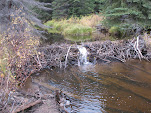
Hand built dam is now overgrown with poplars*.
Of course there were no beavers around.  They had been  exterminated from all but the most remote corners of North America by the fur trappers.   Eric and family got busy rebuilding the beaver dams by hand.  The results were spectacular but you will have to read the book to see what resulted.  Chapter 18 makes the hair stand up on my neck.  It describes how, after 10 years of living in the area, building dams by hand and in so doing, restoring the environment, they acquired their first two pair of beavers which then took over the work of keeping the dams repaired and building new ones.  Below is part of chapter 18.

*Click on picture to enlarge

From Three Against the Wilderness

R.M. Robertson, a native of Glasgow, Scotland migrated to Canada in 1910.  He homesteaded on the flat plains of Saskatchewan in 1914, owner of one hundred and sixty acres of untiled prairie, his home a small hut with a sod roof.  If it had not been for World War I, Mr Robertson might today have been a prosperous prairie farmer, the hut with its sod roof a memory of a day when he hitched his team of horses to the doubletrees of a walking plow and turned the very first furrow in his rich Saskatchewan loam

     But by May 1919, when he stepped out of khaki, all he had in his pocket was a month or two of back pay, plus a hundred or so dollars of gratuity money.  He took a two-bit piece from his pocket, flipped it into the air and closed his eyes.  Heads he went back to the plow, tails he sought other employment.  Tails it was, so with a shrug of the shoulders, the ex-machine gunner turned his back on Saskatchewan's sod and pushed westward into British Columbia.  Outdoor life had ever had a magnetic attraction for Robertson's keen mind and in 1920 he joined the staff of the British Columbia Game Department with the rank of game warden.

     Game warden R.M. Robertson never limited his activities to enforcement of regulations alone, or to apprehension and prosecution of offenders under the Game Act.  He was more interested in what led a pair of Canada geese back to the few acres of water in which the hen bird had nursed her brood to maturity since first she laid an egg.  Of the horns and skull of a bighorn sheep, now crumbling to dust before the indifferent stare of weather, yet still visible on the slope of a hillside that had not been trodden by the species within the memory of living man -- what catastrophe, natural or man -made, had wiped these big game animals from the face of the land?  These and a host of similar questions were ever demanding explanation from the game warden, who whenever other duties allowed, was out on moraine-littered slopes or in sombre conifer forests, eyes searching for some clue that might lead him to the answers.


     The divisional inspector followed many a stream bed from source to mouth, examining the foliage that still clung tenaciously to the banks seeking answers as to why they were now dry.  And he too sensed that in the prostitution of the beavers lay at least part of the answer.

Eric takes up the story.

     Remote though we were in our lonely isolation, not too much touching  upon wildlife matters in his division went unheeded by Inspector Robertson.  Though no game warden had ever set foot upon it -- at least not since we had come to it -- not only its existence but also something of our activities to do with its beaver dams had reached the inspector's ears.  And believing that secondhand knowledge is a sorry substitute for that gained from personal observation, Robertson wrote me that he had decided to visit us and learn of our goings-on for himself.

     One day in late June of 1941 I saddled up my own horse and trailing a spare behind me, rode out to Riske Creek to meet the divisional inspector and guide him back to our cabin at Meldrum Lake.  For at that time it never occurred to me that any mechanical vehicle could possibly navigate the rock-littered track.

     He was cooling his heels at the trading post when I arrived with the horses.  About five feet nine, graying slightly at the temples, his one hundred seventy-odd pounds of well-knit flesh told of a body well tuned to vigorous outdoor exercise.  "He knows what the drag of snowshoes was on a soft day in March.


     Robertson fitted perfectly.  His left hand holding the reins was at the cheek strap of the bridle as it should be, his right on the saddle horn and not fumbling with the cantle.  When he hosted up he came lightly to rest in the seat, right foot instantly finding the stirrup.  The inspector was as used to the unpredictable manners of horseflesh as any cowpuncher working for the ranchers hereabouts.

     Not too much talk flowed between us as now at a trot, now at gallop, with the occasional walking gait between, our horses put the miles behind them.  That was another thing I liked about the man; instead of bothering me with small talk, he held his breath and gave all his attention to the countryside, marking a deer track when one crossed the road or the dusting place of a grouse whenever we passed one.

     Before getting back to Meldrum Lake, one minor incident took place that told me much of the mettle of the man who rode thoughtfully at my side.  We were skirting a small lake whose shoreline was fringed with a waving growth of foxtail grass, now heading out.  I was watching a brood of young ducks swimming parallel to the far shore.  Suddenly the ducklings huddled together and in close formation moved in toward the shore and the foxtail grass.  there they turned and swam parallel to the shore again for a few yards; then, breaking formation, two of them began moving toward dry land.

     The divisional inspector too had his eyes on the ducks.  Suddenly he braced back on his stirrups, brought his horse to a stop and sang out, "
Whoa!"
     After staring intently at the other side of the lake, he breathed softly "over there in the foxtail, fifty feet from those two ducks -- can you see it?"
     Then I did see it, something that might have been a clump of foxtail grass waving in the wind but wasn't.  "Coyote", I announced.

     "The tail of one, anyway, " agreed the inspector.  "The rest of him is hidden in the grass."
     The bushy tail of the coyote was waving gently to and fro like a flag fluttering in the breeze, as the coyote tails have been waving in the long grass at the waters edge ever since there have been coyotes -- and ducks in the nearby water foolish enough to fall for the trick.

     "Curiosity," observed the inspector, "killed a darned sight more than the cat.  The owner of that tail is trying to bring one of those ducks within pouncing distance of its jaws by the simple trick of lying flush on his belly and using his brush as a decoy.  Inquisitive things, ducks, especially young ones."

     One of the ducklings was now out of the water perched on one leg, watching the movement of the tail.  Then at  a clumsy waddle it started toward the grass and the predator that lurked there.

     "This," the inspector murmured "we can not allow." And taking a deep breath, he got rid of it in one noisy shout.

     The Coyote heaved upright and for a split second stood broadside to us, ears in our direction.  Then his keen eyes spotted us, and wheeling, he streaked off through the grass.

     Quacking noisily, the inquisitive duckling scrambled for the water and splashed out to the others.  And breasts low to the water the brood moved into a clump of bulrushes out of our sight.
    "Ever see that type of hunting before?" Robertson asked.
     "Only once, I replied.  "that time it was a young goose, and the coyote nailed it."

     "I wonder," he mused "how many ducks and geese have fallen for that shabby trick since coyotes first got on to using it?"

     The divisional inspector spent close to a week riding-out traplines with me.  He fitted into the life as a shoe fits the foot of a well shod horse.  Come time to wash the supper dishes, he was out of his chair with the dish towel drying as Lillian washed.  He fired questions at Veasy, not only those relating to muskrats or mink, or deer and moose, but also may others to do with mathematics and geography and history and other subjects, usually talked of in a schoolroom. 
And to Lillian he said with a wink, "The adage 'spare the rod and spoil the child' doesn't apply here."

      On the final day of his stay with us, while staring thoughtfully out across one of the marshes, he said musingly, "It seems to me you could well use a bit of help in looking after all these dams.  Did it ever occur to you that if one happened to go out, the sudden rush of water would likely take a few others out below?'

     The thought of that had been bothering us for quite some time now.
At the time of spring freshet, or indeed when swollen by summer thundershowers, Meldrum Creek now more resembled a young river than any minor creek.  A river, moreover, that was barricaded here and there by some twenty-five dams lacking any proper spillway.  So far, none of the dams had been badly breached, thanks mainly to the mass of spruce boughs re-enforcing them.  But eventually the boughs must rot, and the dams settle, as some were doing already.  And if one of the major dams were to give, it was a highly debatable question, whether those below it could withstand the sweep of water that would come pressing in on them.

     As if arriving at some major decision within his own mind, but saying nothing of it to me, he repeated, "Yes, you obviously need some help."  But of what such help might consist of or where it was to come from he offered no clue at all.  Nor were we to be enlightened for a little while yet.

     Later in the year, writing in the Report of the Provincial Game Commission, Inspector Robertson had this to say:  "While on a recent patrol of inspection covering the trapline of Eric Collier, of Meldrum Lake, the potentialities of wildlife propagation were amply demonstrated on this trapline.  With use of only a pick, shovel, and wheelbarrow, Mr Collier dammed up some twenty-five of the old disused swamp lands which were once the habitat of beavers, muskrats, and other fur-bearers.  These areas ranged in size from eighty to five hundred acres each.  The runoff of the winter snows were held and the swamps re-flooded.  This was followed by the rapid appearance of muskrats and other fir bearers, waterfowl and big game, as numerous tracks testified.  In fact the whole situation and appearance of the country changed from one of apparent stillness and dearth of life to animation and restoration of its pristine condition.  The irrigation problems of an area contiguous to the Collier Trapline have been largely solved as a result of the above project.  The Collier project on the headwaters of Meldrum Creek is a brilliant example of what can be done in this very fertile field of endeavour."

     These then were the thoughts of Inspector Robertson of the British Columbia Game Department concerning the events that had befallen Meldrum Creek since we came to its headwaters.  But not until early the following September was I again reminded of his suggestion that "you could well do with a bit of help in maintaining all these dams."

     It was 10:30 A.M.  Lillian was busy with her sewing, stitching her winter mittens.  Veasy was hunched over the table, exploring the mysteries of algebra.  And I was checking traps to make sure their triggering was alright before we set them out in the woods.

     Suddenly Veasy's back straightened and he sat bolt upright, listening.  "What's that?" he exclaimed.

     I too listened a moment, then shrugged my shoulders indifferently as the faint hum of a motor came to my ears.  "Only a plane following the Frazer River north." I said.  For Canadian Pacific Airlines was now operating a plane service between Vancouver, B.C. and Whitehorse in the Yukon, and their aircraft often passed high over our cabin.
     "That's no airplane," Veasy insisted.
     "Then what the heck is it?"
     "A car."
     "A car?  Back here in this neck of the woods!"  I shook my head.  It was inconceivable.

     "It is a car," persisted Veasy, now from the open door.  "It's back there in the jack pines yet, but it's a car and it's coming in here."
     Lillian was at my heels as I heaved out through the door, and together we stood there, gawking in amazement.
     "Veasy's right," I said slowly.  "it couldn't be , but it is a car."

     The uneven throb of an automobile motor, hauling its chassis over a track that was far more suited to steel-tired wheels than one moving on rubber, was now certainly no trick of imagination.  A car was out there on our road, still perhaps a half -mile or more from the cabin but getting closer by the minute.  Soon we caught a flash of its blue body among the jack pines, moving very slowly and cautiously but moving just the same.  And we stood there, blinking and wondering.

     The automobile eased to a stop alongside us, and its driver lurched out of the seat, staggering a little as one is likely to stagger who suddenly finds his legs after being seated far too long.  He was lean and tall, between forty-five and fifty, his eyes for want of sleep, and yesterday's stubble still on his chin.  But who was he, and what was he doing back here?

     The stranger himself quickly answered that question.  "Game Warden Mottishaw, Quesnel Detachment, B.C. Game Department," he introduced himself crisply.  "You're Eric Collier --- right?"
     I inclined my head.  "Himself.  And this is my wife and son -- Lillian and Veasy."

     The game warden touched his cap, smiled a little and said.  "I've already heard about Lillian and Veasy."  Then his eyes went to his car.  He frowned.  "What a road!  Two blowouts, a broken spring, a buckled fender and a leak in the radiator.  I stopped that with chewing gum.  Why in heck don't you move some of those rocks and roots out of the right-of-way?" he barked.
     We've only been back here ten years," I grinned.  "Never got around to fixing up the road yet.  Hope to someday, though."

     The game warden dropped down on a block of wood and pushed back his cap with a slow, tired movement.  He wasn't wearing any uniform, just an old pair of tweed  pants and a coat of a similar material.  "Never mind," he said.  "I got here even if I did have to drive all night to do it.  But they're still breathing, and that's all that counts."

     Veasy's every attention was being devoted to the automobile.  he was fascinated by it.  He walked slowly around it, examining its tires, fenders and springs.  then he went down on his hands and knees, looking at its underbelly.  He peeked into the cab, at the instrument panel and the gearshift.  Then he stepped away, nodding his head, as if all that he'd seen was good.

     Making wild guesses as to who "was still breathing," I said to our visitor. "Step inside; it'll only take Lillian a jiffy to brew a pot of coffee and to get you a bite to eat."  He certainly seemed in need of food and drink.

     But apparently he didn't hear me.  He was at the rear of the car, fiddling with the handle of the trunk.  "Well, where are you going to put them? he asked sharply.
     I looked at him in bewilderment.  "Put what?"
     "Haven't got the faintest idea, eh?"  he said.  "Here, maybe that'll explain."  And he tossed a somewhat soiled envelope over to me.
     I tore open the flap and unfolded the single sheet of paper inside.  The words danced at me as I slowly read them, and their full meaning sank in.

     "Guard them and care for them as if they were children.  They're worth their weight in gold and if anything happens to these, you'll not be getting any more from us."

That's what the paper said and the brief note was signed R.M. Robertson, I/C C Game Division.
     I dropped down on a fender of the car, trying to steady my voice and my thoughts.  You mean they are----"  I began falteringly.  Then I broke off trying to collect my wits, eyes glued on the open trunk of the car.  "Beavers?" I gulped, scarce daring to utter the work.

     "Two pairs,"  the game warden affirmed crisply.  "Live trapped at the Bowron Lake Game Reserve for liberation on Meldrum Creek.  And I'd have you know that game reserve is two hundred and fifty miles north of here, and those beavers have been cooped up in the trunk of the car too long now.  We've got to get them into the water, and the sooner the better.  Where are you going to liberate them?"

     The irrigation dam was the closest and most logical spot in which to set the beavers free.  Each beaver had an oblong tin box all to itself,and one at a time we carried the boxes onto the dam.

     "One pair are two-year olds, the other three," the game warden informed us as he opened the drop doors of the cages.  Each box had to be tilted on end before its prisoners would come out.

     One at a time the beavers were coaxed away from their containers, and one by one they crouched low to the ground, eyes blinking stupidly at the sudden light, nostrils working.  Then the largest one of the lot, a male, I judged, went erect on the webbing of its hind feet, fore-paws doubled against its chest, as if in prayer.

     Smells mighty good, doesn't it big boy?" chuckled the game warden.  "And it'll feel a darned sight better than it smells.  So get going."
     Now that he winded the nearby water, the buck beaver waddled clumsily along the dam a few feet and then slid into the pond.  And with scarcely a telltale ripple vanished into its depths.  One at a time the others took to the water at the selfsame spot, and in  a few seconds, not a trace of them was to be seen.

If you want to read about the effect those beavers had on the area, you will have to get the book but let me assure you the effects were profound.  Another chapter that I find particularly amazing, chapter 27ff,  describes the flood of 1948 which inundated the Frazer Delta -  Every steam in the area added it's water to the river (Except for Meldrum Creek) but I don't want to spoil the story for you.
  

Sunday, October 24, 2010

Terraforming New Zealand - Improving our water resources

Terraforming: To transform the landscape on another planet to resemble the landscape on earth. (wika dictionary)

And that is just about what has happened here in New Zealand. If there ever was a land that looked like another planet, it was pre-human New Zealand and we have terraformed most of it to resemble the northern hemisphere.

Before I start talking about continuing the terraforming, let me make one thing clear. I think that the efforts of Kiwis to turn back the clock to recreate, on islands, the pre-European or even pre-human flora and fauna is wonderful, amazing and very worthwhile. What a great shame we can't bring back the Moa the Hast Eagle and the sea birds.  And I don't confine the definition of islands to pieces of land surrounded by water. In Wellington, for instance, there are the NgaManu and Staglands nature reserves, both of which preserve and encourage native flora and fauna. They are land islands surrounded by pest proof fences in a sea of city and agriculture.

There are also some unlikely types of islands. There are fenced road verges.   In England, they have been found not only to be refuges of plants and animals that are disappearing from farm lands but are corridors for migration. There are military reserves all over the world. Tanks and armoured personnel carriers churn up the soil and practice shooting in these areas so you wouldn't usually think of them as nature reserves. However, people are not allowed in for fear of unexploded ordinance and people are much more destructive than tanks. All manner of species flourish in military reserves. I should imagine that road verges and military ranges in New Zealand also have these benefits.

Potentially, you also have places like wind farms. Put a pest proof fence around a wind farm and let a university come in and eliminate introduced species and bring in natives and you can have islands of native flora and fauna all over New Zealand. This is possible because with a "going concern" (the wind farm) on site with very little impact on the environment, you have enough money to maintain the essential fence. Last but not least, there are home gardens. Plant native trees or bushes and you have many little islands in an urban environment. They provide shelter, leaves for browsing and pollen and nectar for native and also for introduced birds and animals.

All these are great and very worthwhile endeavors but the fact remains that most of the two main islands of New Zealand have been terraformed. If we wanted to turn back the clock we would have to grub up virtually all our forage crops, eliminate cattle sheep and deer, poison our domestic bee, get rid of the earthworms, cut down all our fruit trees and most of our lumber trees and stop growing all of our vegetables. For vegetables we would be left with fern heads and cabbage trees. So lets continue to terraform New Zealand but lets do it slowly, carefully, and with all the precautions we can manage. We have the flora and fauna of all the world to choose from#.

# Have a look at p34 in New Scientist, Jan15,2011 for a take on exotics.


We have to be cautious. We have been stung by the introduction of the rabbit, stoat, weasel, cat, possum gorse and broom. Some would decry the introduction of the many species of deer, the Tahr and the Chamois and the introduction of radiata pine and Douglas fir. We do have a tendency, though, to only see the empty half of the glass.

The rabbit is a huge opportunity for someone who can trap them in large numbers and sell canned curried rabbit to India and canned sweet and sour rabbit to China. Gorse and broom are fantastic nursery species for the planting of forest trees and both fix nitrogen. Deer, Tar and Chamois provide New Zealand with the best hunting in the world. Possum are a source of about the best fur in the world and, mixed with Marino wool  makes the most incredibly tactile sweaters you simply can't keep your hands off of. Our introduced trees provide much of the material for the construction of our houses and support an export industry. For all of that, great caution in introducing new species into New Zealand is of the greatest importance.

And let's say for the sake of the argument that we wanted to bring in a large hunting eagle to nobble up the rabbits.  The black eagle of South Africa would be a likely candidate.  His main quarry is the Dasie.  We would have great trepidations that they would also take lambs.  What to do.  Well, we could bring in ten or so but all males or all females or we could bring in mixed pairs but neuter them.  Give the males a vasectomy so that they would behave completely normally but couldn't have young.

My own favorite candidate for the next introduction is the Canadian beaver. One unique characteristic of this animal is that you know exactly where every beaver is. They build dams and lodges and cut down trees; mainly willows.  If it became necessary for some unforeseen reason to eliminate them, it is relatively easy to do so.  Moreover beavers are self limiting.  When introduced into a new area they overshoot slightly and then fall back to the carrying capacity of the stream.  However, these aren't  reasons to introduce an animal. It only counters two reasons not to introduce them. You can't say with beavers "Oh but if it turns out badly, we will never be able to get rid of them". You also can't say what if the population explodes.  It doesn't happen with beavers. So what are the reasons 'to' introduce them. The reasons are many and varied.

Water Management
Here in Canterbury where I live, we are on a huge alluvial plane which has been created by the out-wash from our high mountains (alps) to the West.   Rivers drop their bed load as they leave the mountains and drop their silt and clay wherever the stream is slow enough. Historically, beds of rivers have filled up with this material, jumped their banks and start to deposit material in a new location. Our rivers act like giant grouting machines spreading material back and forth across the plains. In the 'modern' era we have stopped this process by building levies on either side of the rivers and by allowing companies to extract gravel (shingle) from the river beds.   Underlying much of Canterbury are alternate layers of shingle  and clay.  When we have high rainfall events in our mountains, within two or three days the river rises, the water rushes out to sea and the river falls again. Canterbury itself, while hardly a desert, is on the dry side of the island. This makes it ideal for agriculture as long as water is available. It has been proposed to build great numbers of small concrete dams in the feeder streams all through the headwaters of our rivers. This is to retain water during periods of high availability and release it when water is scarce. Small dams also hold the water longer on the land and increase aquafer recharge. Why not let the beavers do it for free.

Not only will they build the dams but will maintain them forever. No maintenance needed. No expense. And while concrete dams stop the free movement of various plants and animals along the streams, beaver dams do not.  Better still, our rivers have been primed for the introduction of beavers.  Many of them are full of Willows and Willow bark is a favorite food  of the beaver and the remaining branches, their favorite construction material.

Extending the Life of Man Made Dams
As soon as a hydro dam is built it starts to silt up. Bed load forms a delta wherever a stream flows into the dam and finer material settles all over the bottom. Beaver dams catch all this material before it arrives in a hydro-electric or irrigation dam and extends its life. For hydro-electric dams there is another effect.

Increasing the Electricity Generated from a Hydro Dam
One of the largest reducers  of the total energy which can be produced from a hydro dam is uneven water flow. If heavy rainfall occurs in the dam's catchment, water has to be let out over the spillway rather than going through the generators. This water is wasted. With beavers in a catchment, water is retained during high flows and released during low flows#. The flow of the water into the hydro dam is evened out, increasing the amount of power which can be generated from the same total amount of water flowing through the hydro lake.


# Read Three Against the Wilderness by Eric Collier.  Especially Chapter 27.  It goes beyond belief the extent to which beaver dams can moderate flood events. Available in the Amberley and the Christchurch libraries.
 
Creating Wetlands

The value of wetlands is too well known to need rehashing. Beaver dams create wetlands as the ponds fill up with silt and organic material. Water plants grow in the pond, die and sink to the bottom and  shore plants encroach from the sides until the pond is transformed into a wetland. Trees eventually colonize the wetland and another colony of beavers establishes itself and the cycle repeats itself. Over time, the valley bottom becomes higher and higher with a ever deepening water holding sponge. The water storage and release function of the beavers handiwork increases over time, further evening out water flow. Wetlands themselves catch silt and bottom load almost as well as the original beaver pond.

Clearing the Water
There are distinct advantages to clear water. Many fish, including trout and salmon prefer clear water, water plants can grow attached to the bottom when sunlight can penetrate and water treatment for human use is less expensive when there is no suspended sediment. Beaver ponds are very good at trapping bed load and suspended sediment.

Removing Nutrients
When too great a quantity of agricultural runoff seeps into a stream, it can become eutrophic* and inimical to normal flora and fauna. Beaver ponds create a detritus cycle which captures nutrients in a form which is excellent food for a wide range of animals while at the same time keeping the water clear. The detritus cycle depends on all the bits of cellulose (wood chips, twigs, leaves) that collect in beaver dams. Beaver dams also increase the surface area of a stream and hence the amount of sun it collects and therefore the amount of photosynthesis from phytoplankton and rooted plants. Photosynthesis also removes nutrients from the water.

*when nutrient levels are so high that toxic blooms of algae occur, die and poison the water.

Ecological Diversification
If you have a forest with a stream running through it, you have two sorts of environment available for plants and animals - namely the stream and the forest.  Add a beaver pond and you have, of course the pond. You also have an area around the dam which is opened up to sunshine which encourages the growth of herbs, grasses and shrubs.   The cleared area can be as much as a hundred meters from the shore although usually much less.    You create two new environments for plants and animals.

Fish Nurturing
Salmon hatch in gravel beds in streams and many salmon species search out quiet areas to grow before they return to the sea. If they have to fight currents all the time, all the energy from their food goes into swimming instead of growing. Beaver ponds are the ideal nurseries for the Salmon family. Moreover, adult salmon, after spawning, die and are held in beaver dams. The beaver dams catch this huge pulse of nutrients which comes up from the sea and stores it in the surrounding ecology. the food, thus created,  is available to the juvenile salmon when they hatch. Beaver dams greatly enhance salmon runs. They also provide quiet pools for trout.  If you have seen National Geographic films of salmon leaping high water falls with a single bound, you will understand that a beaver dam is no barrier to a migrating salmon intent on his once in a life time act of procreation.

If there was ever an animal that would benefit New Zealand it is the beaver.