Total Pageviews

Friday, July 27, 2012

Peak Shaving

Peak Shaving:  The production of power to take care of the highest electrical load that comes on the system.  It can involve having a stand by plant ready to fire up during peak demand.  It can involve having extra generating capacity in a hydro electric dam so that for short periods water can be used faster than it is entering the dam to take care of this short term load or it can involve pumped storage in which water is pumped into a reservoir during periods of low demand to be used for peak shaving.  There are also ways of avoiding having peak demand and that is what this blog is about.

The blog came about because of an announcement by our New Zealand Commissioner for the environment that solar water heaters are not the answer to our energy problems.  She argued that since solar water heating is at a nadir just when we have our winter peak demand, it doesn't eliminate the need for a dormant stand by generator to peak-shave. Stand by power generators are very expensive since you have to bear the capital costs and the return is poor because of the limited time that the equipment operates.   In this the commissioner is completely correct.  An electrical grid must be able to supply the greatest load that is demanded.  A few cloudy days in New Zealand in the middle of a cold snap and our electrical need surges and we are heating water with electricity rather than sun.  With our present electrical system, she definitely has a point.  However it is somewhat blinkered.

First, and simplest, whenever we heat water with sunshine, we eliminate the use of coal to do the same thing.  This reduced our carbon foot print and since we were generous enough to be one of the first to sign up to Koyto, it is rather expensive for a small country to have a carbon footprint.  Not only does coal produce the most carbon pollution per kWh produced but it is a far too valuable resource to be burnt.  Coal can be used as the feed stock for a huge range of products and if used for this purpose instead of being burnt, would last for thousands of years.

Of more importance, though, is the ways we can eliminate having peaks of power demand.  This involves a number of measures, all of which shift electrical demand away from times of peak energy need.  Smart grids are a large part of the answer.

The best incentive to get people to use power when it is available rather than exactly when they would like to use it is price.  So first we set up a system of varying power price depending on demand.  We have, say A)Power on Demand.  This would be for your lights and your computer which you want to be able to switch on when you need them.  Power on demand would be at the full 22c per kWh no matter when you used it.  B) Option 1.  Option one would be somewhat cheaper.  A Signal would be sent down the line or over a dedicated phone chip that Option 1 power is available.  The power company would send this signal when they had some extra generating capacity they wanted to sell.  Perhaps their dams are full and they would rather sell more power than have the water run over the spill way.

The home owner would have smart appliances.  For instance, he might set his hot water cylinder to option 1 and would only heat water when this option is available.  However to fine tune the system there should probably be a few more levels.  Lets say Option 2, 3 and 4.  Each one is a little less expensive than the previous one.  Each one is signaled by the power company when they have extra capacity and the consumer can dial which option they want on each electrical device they have in the house.

The home owner will also have a read out somewhere in the house to show which option is on offer at the moment.  The smart retired couple, for instance, would watch for less expensive power and do their bread making, hedge trimming and so forth when power is less expensive.    Our equipment must also have the options Take When Available and   Once Started Don't Stop.  Your water heater can turn off and on as often as the power priority changes.  Your dish or clothes washer is a different matter.  When you start the cycle, you don't want it to stop until the cycle is finished.  You might end up doing part of the cycle at a price greater than you dialed  and hence the Once Started Don't Stop option.

The benefit of all this is that power use is shifted away from what formerly were peak hours and the generating capacity of the grid is used more effectively.  The more sophisticated the smart grid, the greater value of all forms of renewable energy, including solar hot water heaters (and electric cars).

Of course a further option is pumped storage.  It is typically between 70 and 87% efficient and New Zealand is probably very suitable for this option due to its high mountains and hills.  Renewable energy becomes particularly effective when you have this form of "battery".

Thursday, March 22, 2012

Pulsating climate

This is a pure bit of speculation.  If true, climate change will result, at least for the transition period, in very cold winters in America, Canada and Eurasia and very hot summers.  First a few facts (or at least accepted theories).

The Gulf Stream which brings warm water along the surface of the ocean from Florida towards the North Atlantic is powered primarily by the freezing out of fresh water ice from sea water in the Arctic and North Atlantic oceans.  Left behind is cold, saltier water which sinks and flows south along the bottom of the ocean.  Water is pulled north to replace this water.

The water which is being pulled northward is saltier than deeper water because of evaporation in the tropics but doesn't sink because it is warmer.  As it flows north, it cools and at some point is heavy enough to sink.  This positive feedback adds more power to the Gulf Stream.

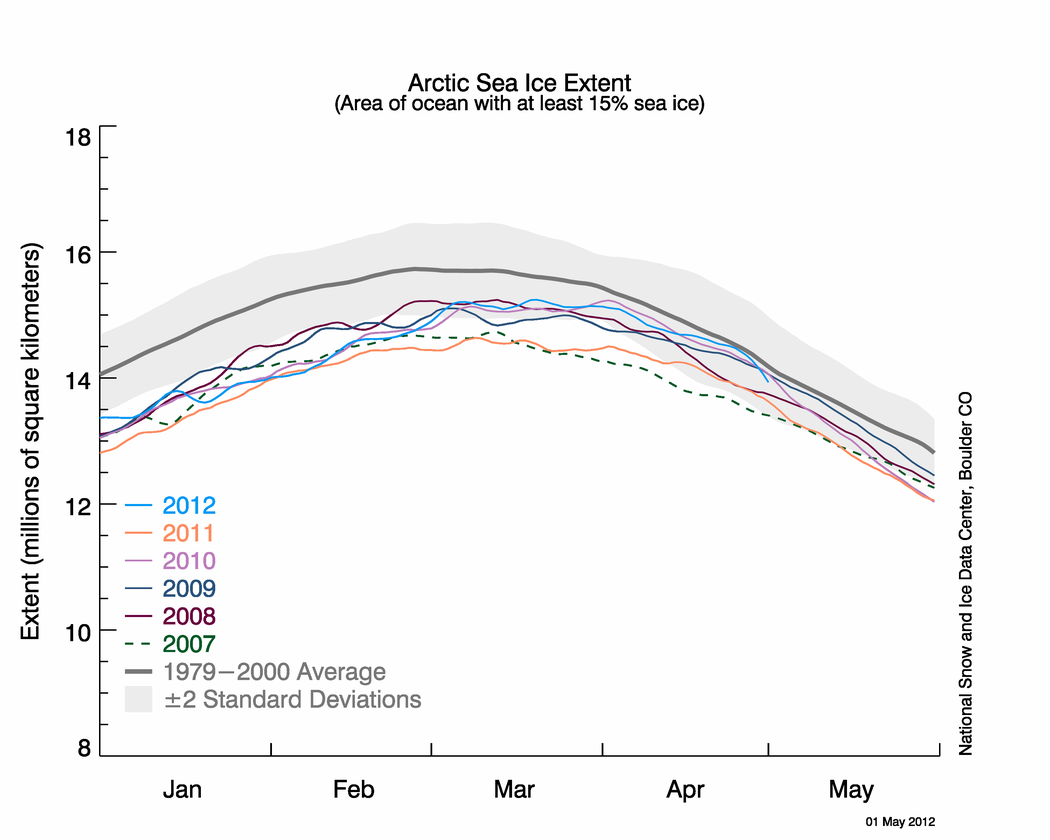
As sea ice (and land ice for that matter) melts, it freshens the surface water in Northern latitudes and so when freezing starts, it will take longer before the resulting water is salty enough to sink. A big influx of fresh water into the North Atlantic should weaken the push that powers the Gulf Stream.

Ice is and insulator.  If you have open water in contact with cooler air, the water gives up its heat to the air, sinks and warmer deeper water replaces it.  The heat exchange between open water and the air is large and heat is being replaced on the surface by convection.  Once you have a cover of ice this convective process is greatly slowed.  Heat has to pass through the ice into the air in order to cool the water in contact with the bottom of the ice.  The thicker the ice the greater the "R" value of the ice.  ie, the slower the flow of heat between water and air.

As climate change continues, the time of net melting becomes earlier* and the time at which freezing exceeds melting is later.    The freezing period shortens, the melting period lengthens.  Here is where the speculation starts.

*Oddly enough over the past few years, the date at which melting starts has been getting later.

I wonder how long the delay is between the start of freezing and hence the sinking of salty water and the increase in flow of the Gulf Stream.  There should be a couple of factors in play here.  First it is a huge body of water to get moving with huge inertia so there should be a delay between push and move.  Think of a huge weight on one of those frictionless pads when you start to push it.  At first the motion is barely perceptible but builds up as you continue pushing.  Similarly, stop pushing and it takes the weight a long time to stop moving.

Secondly, it takes time for the warm salty water from the Florida region to move far enough north on the weakened Gulf Stream where it can cool enough to sink and add it's power to the Gulf Stream.

What strikes me as possible, is as the period of freezing shortens and the period of melting lengthens, we could reach a point where the push (cold salty water sinking) and the result (the Gulf Stream getting up to speed) could be 6 months out of sinkronicity.  We would end up with  a fast flowing Gulf Stream in the summer bringing warm water to the North Atlantic along with warm temperatures and, probably, heavy rain followed by a stalled Gulf Stream in Winter giving us really harsh winters.  Harsh winters would result in lots of freezing of fresh water ice from sea water, giving a push to the Gulf Stream.  It's effect would be felt next summer.

For those who suggest that this will lead to another ice age, remember, it doesn't matter how much snow falls in the winter or how cold it is.  An ice age can only start if the snow last through the summer.  In the above scenario, no snow would last through the summer.  In fact, the remaining glaciers should melt away with all the bad consequences this would bring.

Does anyone know if the flow of the Gulf Stream pulsates in any sort of annual cycle at present.

Post script:   A thought just occurred to me.  During this period of transition to a warmer climate in which the Arctic becomes largely ice free in the fall but freezes during the winter, the push to the Gulf stream should be shorter but sharper.  Clearly the ice starts to freeze later than previously but without a thick cover of ice, the transfer of heat to the atmosphere and the radiation of heat into space is more rapid.  It is possible that the rate of freezing and hence the rate of production of cold, heavy, salty water would be greater than when there is already a thick layer of insulating ice covering the ocean.  The length of the push is shorter but more intense.  How would this effect the whole system??

Saturday, March 10, 2012

Floating villages

For some reason, I have always been fascinated by the thought of a floating village.  My interest was re-triggered by watching the amazing U-tube item on the chap, Richard Sowa, who built an island in a bay in Cancun, Mexico, which floats on plastic bottles held in bags of fishing net.  Have a look at this amazing video.

What a great idea.  I have often thought that the ideal place to put a floating village would be right in the middle of one of the Oceanic gyres.  Everything that floats finds its way into these areas and stays there. This is due to Coriolis.  In a clockwise rotating gyre in the Northern Hemisphere, to-the-right is into the centre.   It is not certain that a floating village that sticks up into the air would behave in the same way as something that is almost completely submerged; that it would say in the gyre but I think there is a pretty good chance it would.  Worth a try. 

An added advantage of this location is that these gyres are full of the necessary building material to build the floats on which the village would sit.  Tons and Tons of plastic waste are caught in these gyres.  There is a technique *  for melting unsorted plastic waste into  viscous liquid that can be injected molded into whatever form one wishes.  UV resistant chemicals would have to be added.  Better still, the link talks about the use of solar energy to accomplish this.  One little fly in the ointment is that all the pieces of plastic trapped in the ocean gyres of the world will have a film of organic material on them and often various fouling organisms.  One might have to find a way to clean the plastic before it could be used.

* Scroll down to the item on plastics in the above link.

I picture floats of, say, the size of a dining room table linked with flexible couplings to adjacent floats with a plastic factory chugging away, turning out new floats.  Rubber tires might make the ideal link as they are in great supply and themselves float if they are placed upright to trap air.    They are almost indestructible.  As the floats are finished, they would be fastened to the island which just grows and grows.  The plastic melt can also be extruded rather than injected molded to make a wide variety of construction materials.  You can have solid rods, pipes, I beams, U beams or any other form you wish.  As the floating island becomes large enough you would add an extruder and manufacture light, strong members for the skeletons of your buildings.  You might be able to extrude the material with closed bubbles, making all the elements of the structure buoyant.

Note that it is sunny most of the time in the oceanic gyres, giving the likelihood of lots of available solar energy.

In case you are picturing a sterile sort of environment like the one in the movie 1984, look at the first link.  Richard planted Mangroves on his bottle-supported-island which grew very quickly with, of course, its roots in sea water and had various drums and pots growing tomatoes and other vegetables.  So what would the people do on this floating island.  Not everything could be produced on the island and it would be valuable to have an export product to trade for goods from the mainland.

My first thought is oysters and specifically the Pacific oyster.  The main reason that this came to mind is that I used to grow them as one of the crops of a mariculture farm.  Oysters need plankton to grow and diatoms are the best plankton.  So how do we grow plankton in the sunny but oligotrophic* water of the gyres of the world.

* Very poor in nutrients

The answer is to access the cold, nutrient rich water below the thermocline.  This is found at around 300m  in many tropical oceans and here we can use the wave action to do the pumping.  While there is not much weather in the center of the gyres, waves are sent across the oceans from all around.  By the time they reach the gyre centre, they are pretty gently rolling swells but that is just fine for our pump.  Black Polypropylene pipe is almost the same density as sea water.  If you put a weight on one end of, say a 400 or 500m piece of pipe, it will hang vertically in the water with only the mass of the weight you put on the bottom needing to be supported on the surface.  The pipe itself is virtually weightless in water.   So we connect this pipe to a float and attach a right angle at the top which feeds into a pipe that goes to our mariculture unit.  Now all we need is a one way valve somewhere in the pipe which allows water up but not down.  As a swell lifts the float and with it the pipe, the whole column of water is given an upward momentum (along with the pipe which is moving upwards at the same speed).  As the trough drops the float, the weight pulls the pipe down, the water continues up as the one way valve opens and water pours up the pipe.  If you need more water, you put down another inexpensive pipe.  So what do we do with this water.

Once we have this nutrient rich water in the euphotic zone, and remember, the centre of gyres are almost constantly sunny, Algae blooms just take off.  Almost certainly, there would be some phytoplankton in the water that would inoculate the process but if not, it is easy enough to inoculate the water. You might have to add a little water glass to the incoming water to encourage diatoms, perhaps not.  If so, water glass is cheap.  There might be a need for a little Iron salt too.  Apparently ocean water is quite poor in Iron.  So where does this water go.

To grow diatoms we need to hold this cold deep water in the euphotic zone for one to two days.  So in our float system, we leave a space and put in a membrane, shaped like the nets that salmon farms * use to grow salmon.  Essentially a pond. We attach it so that the rim is above the sea and organize the outlet so that the water in the pond is, say, 10cm above sea level.  The slight resulting 'head' (pressure) is what keeps the "pond" inflated.

*ps.  I have a lot of reservations about salmon farms which are actually feed lots, not farms,  but the video does show what sort of set up could be used in a floating oyster farm.

From the phytoplankton pond, the water flows through similar structures in the form of a trough with racks of oysters in the water stream.  The cycle for oysters is about 9 months in these types of conditions from spat to commercial size.  Oyster spat can be obtained from a variety of hatcheries around the world and could very easily be produced on our island.  The system is not complicated at all.  So what about the water that leaves the oyster troughs.

The oysters have utilized the plankton and mineralized* the nutrients they don't use.  The nutrients are in the ideal form to be taken up by macro algae (seaweed) of which many varieties have a good market.  Think of the seaweed that is wrapped around Sushi or the sea weeds from which Carageenan or Agar are refined.  Growing sea weed has the added advantage of removing nutrients from the water before it is returned to the ocean.

* Turned them back into simpler compounds.

You might wonder where the fresh water will come from for drinking, cooking and growing plants.  Fortunately we have the cold water from the depths to use. Water from 400m is about 7 degreesC.  Water from the surface, 25 degrees or more.  Using a bit of the electricity from the solar panels to power a vacuum pump, you can make the surface water in a closed vessel boil and it can be condensed using the deep cold water in a heat exchange.  It is possible that Multi-Stage flash distillation would be the most efficient option.  Experts in the field would be able to design the best system. With the humid air of the gyre, you might even be able to condense water out of the air using the cold deep water.  Ideally, you would use the cold of the deep water to make fresh water and discharge the warmed sea water into your mariculture system.  What else could the village do.

One of the most lucrative activities would be tourism.  Complete isolation, great sea food and warm tropical waters to swim in (inside a net to keep the sharks out) would be very attractive plus the completely unique nature of the vacation.

Since we are creating a mid ocean mini upwhelling, a unique assemblage of animals would likely develop around the village.   The village would act like a FAD (Floating Agrigation Device).  The village could also rent out space to one of the marine research institutions of the world such as Woods Hole or Scripts.   

One problem would be what to do with human waste, vegetable scraps, chicken manure and so forth.  Whatever portion of this the community felt comfortable with could be turned into compost via a worm farm to be used in growing vegetables but the rest could be turned into biogas which is about 70% methane and 30% Carbon dioxide.  Biogas can be used for cooking or for heating the plastic making equipment. It can also be used to run a diesel generator.  After the biogas has been generated, the remaining material still has all the necessary nutrients for gardening.

The key to this idea is developing a system that can turn contaminated plastic into durable floats which can be linked to make a large platform.  If the plastic units can be manufactured so that the material itself is lighter than water, so much the better.   

Of course, a floating village does not have to depend on plastic floats.  One could make them out of a variety of materials and even cement.  It would be, though, at the very least psychologically  nice to have floats that would continue to float even if filled with water.  This leaves the possibility of patching up a hole, bailing the float out and continuing to operate.  Nothing wrong with a combination too.  The first floats might be commercially made to form the nucleus of the village followed by the utilization of plastic trapped in the gyre.


Monday, February 20, 2012

carbon sinks

Glaciated periods (glacials) end with a sharp increase in Carbon dioxide.  It looks most likely, as odd as it seems, that the rise in CO2 is the result rather than the cause of the melting.  In a couple of former blogs, I suggested why this might happen.  The release of CO2 then accelerates melting, in a feed-back loop.  Over the subsequent  years of the interglacial, carbon sinks continually reduce the level of atmospheric Carbon dioxide.  When Carbon dioxide levels fall sufficiently, snow begins to accumulate at high latitudes and high altitudes in the summer and we edge into another glacial.  I'd like to try to catalog as many potential sinks as I can think of, regardless of their perceived importance.  Others can work on working out which ones are significant and which not on the road to the next glacial.

Note that you can reverse each of these arguments to see what we are doing to increase atmospheric Carbon dioxide.

Corals
Corals and all other marine organisms that have a Calcium carbonate shell are sinks for carbon dioxide.  Every molecule of CaCO3 contains one molecule of Carbon dioxide (60.6% by weight).   In addition to the building of reefs by oysters and corals, some phytoplankton have calcium carbonate shells.  There are globigerina, a type of foraminifera, pteropods, a swimming snail and so forth.  When these die, they sink to the bottom of the ocean and form calcareous oozes.

 Curiously, at great depth (below about 4500m) the calcium carbonate dissolves so these oozes only form in medium deep water.  The white cliffs of Dover are such deposits and give a visual indication of the extent of carbon sequestration in the form of calcium carbonate that phytoplankton can effect.

Note: In an item I just saw on Discovery Channel (Feb20,2012) it appears that corals are much more common in the deep ocean than previously believed and even form quite large "hills" of Calcium carbonate in some locations.   This sink would presumably stop if the ocean overturn ceased and the deep ocean became anaerobic but as long as the system is working, deep water corals are another significant sink.

Question:::  What happens when this water which is enriched in dissolved Calcium Carbonate upwells into  shallower water???


Of special interest with regard to corals in the photic zone is that they are limited in their growth by the surface of the oceans.  If you have visited coral reefs you may have seen some of the brain corals which show concentric rings on their tops.  These rings are caused by  very low tides which have killed off the top of the coral.  As the diameter increases a new ring is formed.  Rather than recording yearly growth, these rings record king tides.  Corals don't grow in air.  Following the end of the last (and every other) glacial (ice period), the sea rose.  At the maximum extent of the last glacial the sea was about 120m below its present level. The last glacial lasted for about 125,000 years since the end of the Eemian interglacial.  With various smallish ups and downs, the sea level steadily dropped to this lowest point of 120m below its present level.  Coral reefs, of course, died as they were exposed and then a hundred thousands  years of waves pounded on the shore, washing the corals away, leaving cuts into the land.  Around 20,000 years ago the ice began to melt but the melt only really got under way about 11,000 years ago.  Sea level rose  quickly (in geological terms) to its present level.   During part of the transition to our present Holothurian interglacial, sea level occasionally was rising as much as 56mm/year.  The over all rise during the melt was about 6mm per year, twice the present rise.  For reference, at present (2012), the rate of sea level rise is about 2.8mm.yr.   


In tropical areas, corals grew to fill this 120m gap up to the surface of the ocean, an over all growth rate of 6mm per year.  It is estimated that the total area of coral reefs, world wide is 284,300 Square Kilometers.  This figure times 1,000,000square meters per square km times 120 meters depth times 2.5sg (specific gravity) for limestone times 60.6% Carbon dioxide in limestone  divided by 1billion gives a figure of 5,174 gigatons of Carbon Dioxide sequestered in corals since the end of the last ice period. To put this into perspective the total Carbon dioxide in the atmosphere today is about 3000 gigatons.  Corals which have grown since the ice age have sequestered about 1.6 times as much carbon dioxide as the Carbon dioxide at present in the atmosphere.  As sea level rises, we have a potential carbon sink in corals as long as we don't kill them with acidification or thermal shock. massive coral bleaching could, of course,  shut down this carbon sink.

Ocean Overturn
At the poles, sea ice freezes out fresh water ice leaving salty brine behind.  This brine is heavier than open ocean sea water and hence sinks.  As it moves across the ocean bottom, it picks up nutrients from the mineralization of the constant rain of organic material from the surface.  Where wind conditions are suitable, surface water is pushed away from the shoreline to be replaced by this upwelling, nutrient rich water.  As this water comes into the photic zone, productivity is immense.  The ocean off Peru is an example and the Anchovi produced there provides a significant percent of the fish meal for world animal production.  The Atlantic overturn is another example with the Gulf Stream being the surface manifestation of this overturn.  The shut down of such ocean systems would cause Carbon dioxide to rise more quickly in the atmosphere

Swamps
If the water in a swamp is sufficiently stagnant and there is sufficient organic loading to make the bottom of the swamp anaerobic, then all cellulose that falls into it is preserved.  This includes all plant material and probably explains the formation of many of our coal measures.   If the area is sinking, the organic material is buried, heated, gives up its volatile fraction and what remains is mostly carbon with some mineral material which forms the ash when coal is burnt.  This process removes carbon from the atmosphere and also contributes to sending us toward another ice age.  

Growing Forests
A mature tropical forest, at first glance, would seem to be a huge sink for carbon dioxide.  After all, the rate of photosynthesis is huge.  This is an illusion.   Once a tropical forest has truly reached maturity, the rate at which vegetation dies and is oxidized equals photosynthesis.  Mature tropical forests, however, do represent a large sequestering of Carbon as long as they remain untouched but they have no net effect on removing more carbon from the atmosphere.

The carbon content of organic material, wood included, is about 50% of the dry weight of that material.  If an plant is 80% water, 20% dry matter, then it's carbon content is about 10% (of its wet weight). The cutting down of the forests of the world has released a large amount of carbon into the atmosphere and this carbon would be rapidly taken up by letting the forests grow again.  In this way, tropical forests could be a huge carbon sink if allowed to regrow.  The only way a mature tropical forest will continue to sequester carbon is if it contains swamps as detailed above.  Of course another way is to selectively log tropical forests (at a rate that doesn't imperil their survival) and to use the wood in long lasting buildings, furniture etc.  New trees grow where the old ones are harvested and a mature tropical forest then becomes a carbon sink.

New forests are a whole different ball game.  At the maximum extent of the last period of glaciation ('glacial' as opposed to 'interglacial'), ice, estimated to have reached a depth of 3km, covered most of Canada and a strip of America down to and extending beyond New York.  Much of Europe, Germany, Poland and  Russia and the UK were covered.  Smaller ice sheets were found on high land right down to the equator (Mt Kilimanjaro, for instance).  When the continental glaciers melted all the scraped-clean land was open for colonization (primary and secondary succession).  Much of this land ended up clad in forests of giant trees with their sequestered carbon.  As the tree line moves north with global warming, we have another potential carbon sink.

While we are at it, temperate forests are a different situation from tropical forests.  When Tropical forests are clear felled, it is found that the soil is thin and is exhausted very quickly.  This is due to the characteristics of humus.  Humus is the final break-down product of organic material and contains a lot of carbon.  Amongst it's other characteristics, it holds nutrients in a form that can be used by plants.  Above about 25 degrees C, Humus breaks down.  

In temperate forests, the humus builds and builds, depositing more and more organic material in the ground.  When temperate forests are clear felled, agriculture can carry on for far longer than in the tropics, before the soil is exhausted. Temperate forests can continue to sequester carbon even after they are mature (with respect to the total mass of live vegetation they contain). The re-establishment of temperate forests not only would sequester considerable carbon but continue to sequester carbon when the forest is mature.  It is a bit rich for northern hemisphere countries to complain about the destruction of tropical forest when they have decimated their own forests.

Permafrost
During the summer, the top foot or two of permafrost melts and a range of dwarf, ground hugging trees, lichens and mosses grow.  In the winter this freezes.  Each year another small layer is added and the layer of organic material deepens.  Permafrost areas are carbon sinks.  Of course, the flip side is that thawing them with global warming is a source of carbon. It is estimated that the carbon stored in permafrost today is greater than all the carbon of all living things and is twice the carbon in the atmosphere.     If the layer is deep enough (about 300m) the pressure is great enough that a portion of this carbon is in the form of methane clathrate which only needs a little warming to be released. In addition, any geological methane seeping up under permafrost can also be stored as clathrate as it comes into contact with moisture.  The depth of the frozen soil is not the only factor for the creation of methane clathrate.  The frozen permafrost can act as an impermeable layer, like the lid of a pressure cooker and clathrate can form at shallower depths.

It is interesting to note (and counter-intuitive) that by covering an area of permafrost with a deep layer of insulating  ice during a glacial, the permafrost will be melted by the heat coming up from the earth.  This deep organic soil would break down anaerobically giving up methane.  This would likely collect at the bottom of the ice sheet as a methane clathrate, ready to be suddenly released when the ice sheet melted.  Of course, the clathrate already stored in the permafrost would give up it's methane too which would seep up and be stored in the ice sheet. This may be part of the explanation of how Carbon dioxide rises so quickly at the end of glacials.  Released methane trapped under the ice oxidizes rapidly into Carbon dioxide and shows up in bubbles in the ice cores from Greenland and Antarctica as Carbon dioxide rather than as Methane.

Note that the Firn layer (permeable top of an ice sheet) is about 70m and gas can diffuse between this layer and the atmosphere so the signal of sudden methane or for that matter Carbon Dioxide would be smeared out throughout the layers.

Grasslands
Native grasslands have most of their biomass underground.  This is an evolutionary adaptation to fire.  Grass fires are intense but short and the heat doesn't penetrate far underground.  With the introduction of nutrients from wind-imported-dust, grasslands in their natural state continue to grow upward and add more and more organic material.  Organic material is ultimately stored in deep rich humus containing soil.  This rich accumulation of nutrients was mined by farmers planting wheat and other crops, especially in the great plains of America, and the carbon returned to the atmosphere.  In pre-agricultural times, grasslands were carbon sinks. Now they are sources of carbon.  If returned to their native state, they once more would sequester carbon.  Some research suggests that the north American Buffalo can produce more meat per hectare on native North American prairie than our much vaunted beef cattle.  At the same time they allow the sequestration of carbon to once more occur in the grasslands. Have a look at this TED talk on how to restore our grasslands.  Direct seed drilling without plowing has also been shown to increase the Carbon content of soils.

Calcareous Oozes 
Many plankton animals such as foramanifera have calcareous tests.  These sink  form layers of calcium rich deposits on the ocean bottom up to about 4500m.  Below this depth, calcium carbonate is soluble.  These oozes get buried and are carried toward subduction zones by the ocean bottom conveyor system.  Over geological time, these deposits of lime are recycled by volcanoes as Carbon dioxide. 60.6% of calcium carbonate is Carbon dioxide. When you think of deposits like the chalk cliffs of Dover it is apparent that calcareous deposits are a large sink for Carbon dioxide.

Silicate rocks
As erosion or volcanic activity exposes new silicate rocks to the atmosphere, they are attacked by Carbon dioxide, producing carbonates.  This is also a sink for Carbon dioxide but on a geological time scale.

Cement
As cement is produced a large amount of CO2 is released.  As it cures the Carbon dioxide is re-absorbed.  All cement structures around the world are slowly absorbing some of the Carbon dioxide that was released when they were produced.

 Carbon sinks are slow but inevitable.  As they proceed, the Carbon dioxide content of the air decreases, the climate cools until snow can begin to accumulate over the summer.  It would appear that with the amount of sequestered carbon we have introduced into the atmosphere by burning fossil fuels, the next descent into a glacial  will be much delayed.  It is interesting to think that we will have used up the world supply of sequestered carbon in the blink of an eye.  We would expect the present interglacial age to last another 10 or 20 thousand years.  With our Carbon output, let's say we have pushed the end of the present interglacial out to 30,000 years.  If we still exist then as a species, which seems unlikely, our descendants will be faced with the onset of a glacial age with no large resources of sequestered carbon left to counter it.  

Friday, November 25, 2011

Car ChargingPower Points

With electric cars finally beginning to enter the domestic fleets of the world, we are going to need lots of charging points.  Everyone with an electric car will have a power point at home.  In fact you already do.  As long as you don't want fast charging, all you need is an extension cord from the nearest outlet.  This will give you somewhere between 10 and 25 amp charging, depending on your individual electrical set up.  However, here we are talking about charging away from home.

Commercial charging points will spring up in company parking lots, along streets instead of, or integrated into parking meters, at restaurants, in high rise commercial parking lots and so forth.  What characteristics should they have.

You should be able to swipe your card and then choose a number of options.

  With respect to the amount of power you want, you should be able to choose full charge or a given amount of money or a given number of kWh (kilowatt hours).  If, by chance, you chose more than your car can take at the time, you would only be debited for the amount you used; not the amount you asked for.

With respect to the supply options you should be able to choose Charge now (at the full day time cost per kWh) or option 1, 2 or 3.  Option 1 would cut in when the power company sends a signal down the line or over a dedicated phone chip that because of extra generating capacity, somewhat cheaper electricity is now available.  Option 2 cuts in when the uptake of electricity by offering Option 1 is not enough to balance the load with the supply and option 3 a further reduction in price to bring  even more load on line.  Each option gives the consumer less expensive electricity than the previous option and allows the power company to sell more electricity and not waste water.
 
This is supply balancing and has some definite advantages over the present supply balancing.  Every kWh you take when it is available is one less that you take when supplies are low.

At home, if you have a dedicated, smart-charging point you might even have option 4.  Option 4 is "Charge and Supply".  You would use this one when you are not going to be using your car for a while.  You might be on vacation overseas or you might only use your car on weekends so the car during your holiday or during the week  would be plugged into Option 4.  With this option, your car will receive charge when option 3 (the least expensive electricity) is available and will send power back to the grid when the power company signals that it needs some peak shaving (high load and hence a short term need for extra electricity).  In this mode, your electric vehicle will generate a small but very welcome revenue for you.

Hopefully, the power companies will be smart enough to realize that if they set up the system to allow the customer to save money and to have options, they gain as well.  They gain by being able to sell more of their power rather than letting water flow over the spillway or having to feather their wind turbines.  They gain by not having to build a dedicated, very economically wasteful  power station just for peak shaving and they gain by having the good will of their customers.  They also help their country and the world by putting less carbon into the environment.  Systems as described above are ideal for using intermittent renewable power sources such as wind, hydro and solar and if you have a charged battery in your car, charged when excess energy is available, you will  demand less  power when fossil fuel must be used to generate it.