Total Pageviews

Sunday, March 17, 2019

My take on terrorism

This is my take on the creation of terrorists; of people capable of the utterly unspeakable events which took place in New Zealand on the 15th of March 2019.  And of what we should do to stop the creation of more terrorists.  Broadly speaking there are three types, two of which are relevant to this conversation.

First there are people who have had their lives disrupted by war and want revenge on the perpetrators.  At least on the face of it, the taking down of the trade centers in New York on 9/11 was such an attack although there remain serious questions about who was actually behind this attack.

The second type are what we characterize as alt-right terrorists.  These are often white supremacists who think that they are justified in going into a mosque and shooting people at prayer.  The atrocity in New Zealand was such an attack.

A third type is a lonely student, bullied by his class mates who shoots up his school. This type is not relevant to this discussion.

 Imagine yourself in a country that has been attacked by a powerful country for no better reason than they want your resources and want to provide business for their arms manufacturing industry. Co religionist countries around you have also been attacked and exploited for their resources. This powerful country assassinates people extra-judicially in your country and in near by countries by flying drones overhead, killing whomever they want to.  Worse still they have no thought about the so called collateral damage (others killed at the same time). They kidnap people and send them to be tortured, often for no better reason that some jealous person said they were a terrorist. They practice a whole series of steps to create regime change in other countries* up to and including sending in their army and then have the utter hypocrisy to  complain when someone even tries to influence their elections.  What would be your attitude to this country.  What would you do.

*Perkins - Confessions of an Economic Hit Man.  Stone and Kuznic - The Untold History of the United States of America

The second type is the white supremacists, they are greatly encouraged and made to feel justified by the actions of that same powerful country that continually foments unjust wars and kills people, usually brown,  in other countries.  This powerful country also behave toward large parts of their own population as if they are inferior.    This gives the white supremacist  nutters tacit encouragement and approval to commit acts such as occurred in New Zealand.  I hope it is clear to you which country we are talking about.

There is yet another motivation for white supremacists.  Recently we have had huge tranches of people migrating all over the world.  A large proportion of these are from countries that America has stirred up with her never ending wars.  The refugees don't want to be in our countries.  They would much rather stay at home and live  a peaceful existence.  Their home countries have been made uninhabitable and they have been given no choice but to immigrate.

A disproportionate percent of these immigrants are young men.  In Rotherham in Northern England, in  Germany and in Sweden to name a few locations, a rape culture has developed.  Just having a huge influx of single men into a society is already a formula for unrest amongst the indigenous population exacerbated, possibility, by a different "dress culture" which makes these young men think the local women are fair game.  Whatever the reason, having a group of men, easily identified as 'others' raping your women is a power keg waiting to be ignited.  Most of the population does not resort to acts of terror but there is a huge ground swell against immigration in countries that have accepted massive numbers of these displaced people.

Perhaps our anger should be directed to the creators of terrorists, rather than the terrs, themselves.

It sheets back to America causing refugees to leave their own country and seek refuge in the West.

So the question is, what to do about it. Are we going to be reactive or proactive. Clearly the answer is both but I feel that the proactive part has almost been ignored.  Can we do anything to stop the creation of terrorists of both types before it is too late. I believe we can but it is will be  hard and will require speaking speaking truth to power.

We can't go physically against the powerful country and besides even if we could, we would be adding to the same problem of violence we are trying to ameliorate. No, what we have to do is to be a voice against this continual war mongering when we see it building up and before it turns into a hot conflict.  Our main weapon is our news and current affairs capacity, publicized through podcasts and youtube. 

We decry the showing of extreemist content on social media but social media which spreads podcasts and youtube items is just a tool.  Let's use it to our advantage.

Here in New Zealand we punch above our weight and have a considerable reputation for fairness.  In part this was earned by our stand against atomic weapons and atomic powered military ships in our waters.  We took-on the same world power that is warring against the brown people of the world despite the economic hardship that it caused us. We are also known as the first country that gave suffrage to women.

At this time we have gained huge credibility by the actions and words of Jacinda following this abysmal senseless act of terrorism on our soil.

At present (March 2019) we see this powerful country up to the same old same old tricks.  In case you think this is something new under Trump, read this. The USA has done this to almost every Latin American country in Central and South America and is now doing it to Venezuela.  She has also done this in many other countries around the world and I understand that she operates a "school" where she teaches locals from other countries how to overthrow their governments.

At present  she is also  carrying out a ghastly war in Yemen through her surrogate Saudi Arabia, creating  markets for her arms without any risk to her army.

America has put sanctions on Venezuela to stop anyone trading with her and  frozen her monetary assets in American banks.  Venezuela can not buy food and medicine overseas and the Americans are using the suffering that America itself has caused to stir up a population that doesn't realize what the source of their suffering is.

To add insult to injury the USA sent food aid to the border of Venezuela to make the administration either look incompetent (if she accepted the food aid) or evil (if she  refused to allow the aid in). In the past, America has used false flag operations again and again and this is just another variation on the theme.

What we need from our media is in depth articles on the history of such actions by America and how she is operating at present in Venezuela to try to head off yet another terrorist-creating, refugee-creating atrocity. Because of the way international media operates today, articles that are pod cast and are on youtube  are likely to reach the widest audiences through social media.  Shine light on what America is doing.  Their sort of crime withers under light.  A series of articles, building up from the history of such actions to the present day will have the greatest impact. A series like this builds an audience from item to item as it becomes popular.

In the aftermath of the killings in a New Zealand mosque, we are up in arms about the social media not taking down the video of the shooting more quickly.  Fair enough.  But the social media is just a tool.  Let's use it for good rather than evil.

Our National Radio is the tool we should be using.

Tuesday, February 5, 2019

Flooding

It would appear that we are going to have ever increasing flooding on into the future.  On land, rain is coming in more extreme bursts and, as warm air can hold more moisture than cold air,  in many locations there will be more total rain.

On the sea shore, the sea is rising and storms are becoming more intense so higher storm surges will be added to an ever higher sea level.  Areas that were never flooded before will be..

In addition we are seeing a further effect of climate change.  Weather systems are sometimes getting stalled over certain geographical areas instead of continually moving around the globe.  If this is a 'ridge' you are likely to have prolonged drought.  If it is a 'trough', you are likely to have prolonged rain.  We saw this in Townsville in Australia (beginning of Feb, 2019) where they had almost 400mm of rain on each of 4 consecutive days.  I can't even imagine that much rain.

So what are we to do.  We can build up levees to hold rivers in their beds and build walls to keep out the sea but just look at the cost.  And with an ever increasing problem, any such solution will be overcome in the future.  There is a far better and less expensive solution.

In areas that get flooded, the insurance companies should be held to account by the government and forced to honor their commitments.  We saw in the Christchurch earthquake how reluctant insurance companies are to pay up and how they delay any way they can.  In addition to the insurance the government should top up the pot so that the victims are generously compensated but that is it.  The area is then zoned as un-insurable.  The people can stay if they want but they have had their one time pay out.  If they get flooded again, (and if it happened once, it will only be worse in some future event), they are on their own.  They had the option to take the money and move to higher ground.  If they didn't take it, too bad.

Of course, any area that is flood prone but hasn't yet been built on (if there are any such) should be declared un-insurable for floods and no buildings ever allowed on them.

This is a far less expensive option than trying to hold back the floods and the tide.

Better still, the expense is spread over time rather then local and fedral authorities having to come up with huge tranches of money to do major civil engineering works that will be obsolete sooner rather than later.

So what about the land that remains empty.  If it is on a river flood plain (where we never should have built in the first place), it can be used for agriculture, turned into a park or left to regenerate native vegetation.  Incidentally, allowing a river to spread over it's flood plain, reduced the height of the flood downstream and so protects other properties.  This is even more effective if the area is well vegetated with shrubs and trees.

Alternately, shore areas can become nature reserves. Sea shore areas, if vegetated, will tend to collect silt and build up over time, aiding in the defense of landward properties.  On the sea shore, salt tolerant plants can be introduced.  They hold the soil, reduce wave damage and moderate the force of subsequent storms.  They can become mud flats with all the benefits this brings to the bird life of the area.

It doesn't seem likely that we will take the necessary measures to reduce our carbon output to the atmosphere.  In fact, following a few years of steady output, in 2018 we actually increased Carbon dioxide production once again.  This in spite of more and more renewable energy coming on line and ever increased efficiency in lighting our streets and buildings and powering our machinery.

We are so clever individually but so abysmally stupid in the collective.  Let's at least be sensible in reducing the cost of flooding and spreading it over a longer period.

Friday, January 18, 2019

Nano-Aluminum-New Energy Source

Sorry, but it is complete BS - at least the way it's being presented.  I'm not saying that there is no place for nano-Aluminum in the pantheon of energy systems but not as implied.

I get this investment advice site on the web and they are promoting nano-aluminum as the energy source that will soon be found powering virtually everything in our modern society.  They don't say it in so many words but leave the impression that nano-Aluminum - very small particles of Aluminum, is a catalyst which causes water to disintegrate into it's component parts, Hydrogen and oxygen, and that it does this at room temperature.  Either they are ignorant of the most basic chemistry and physics or they are trying to play the market so that they can make a buck on it's ups and downs.  Let's start by looking at what it would mean if Nano-Aluminum was such a catalyst.

As anyone who has taken first year chemistry in High School or even basic science in year 9 knows, a catalyst does not take part in a reaction.  Rather, it enables a reaction to proceed and quite often at lower temperatures than would be necessary without the catalyst.  In some cases the reaction would not occur at all without the catalyst.  So let's pretend, for a moment, that nano-Aluminum is such a catalyst.  What would bubble off.

You are probably way ahead of me.  We would have bubbles of the perfect stoichiometry* mix of Hydrogen and Oxygen  in the exact proportions to convert back to water with one mother of a bang with the slightest spark. And you certainly wouldn't want to try to compress this mixture into a high pressure tank!!!  Let's look at the claim that this is a source of energy.  Clearly the reaction would be endothermic.  It takes energy to split water and if this reaction took place at room temperature, the reaction vessel would cool down, creating a 'delta T' (temperature difference).  Heat from the environment would move toward the cool reaction vessel and continue the reaction.

*Reagents in proportion so that when they react, none of the reagent is left over. All of it reacts.

Of course you could add heat from, say, solar panels, to speed up the reaction but my investment-advice-web-site is presenting this as a source of energy.  Mind you it would be pretty neat and you would have found a way of absorbing surrounding low level heat energy and converting it into a high energy mix of H and O. 

What the reaction between nano Aluminium and water actually produces , is pure hydrogen which can be used in a fuel cell which  by the by, also work at room temperature. What is actually happening here chemically.

The Aluminum is pulling the oxygen off the water, forming Aluminum oxide and in the aqueous environment of the reaction, probably Aluminum Hydroxide and releasing the Hydrogen.  Nano Aluminum is not a catalyst but a reagent which is taking part in the reaction and is used up.  So let's look at how we got our Nano Aluminium in the first place and particularly how much energy went into the process..

First you ship the Aluminum ore, Bauxite, from where it is mined to somewhere that has abundant electricity.  First energy cost.  Aluminum is a tri-valent element.  That means for every atom of Aluminum released from the Bauxite, three electrons are needed. Second energy cost. It is an electrically hungry process but this is not all.  The process takes place in molten reagents.  You have to heat up the Bauxite and other reagents to 1000 degrees centigrade.  No matter how well insulated your reaction vessel, it looses heat and energy must be constantly added to keep the temperature up. Third energy cost.  Then you have to ship the ingots of Aluminum to where they are turned into nano-Aluminum. Fourth energy cost.  And finally it takes energy to convert a block of Aluminum into nano Aluminum. Fifth Energy cost.  We could add one more.  The energy cost of shipping the nano-aluminium to where it is to be used.


But this is all moot.  In fact, as noted above, the Aluminium is not a catalyst.  If it was a catalyst, all the above energy costs would be worthwhile since the Aluminum would remain for a very long time or perhaps forever without being used up and you would have a continual source of hydrogen (mixed with Oxygen)

The Aluminum pulls the oxygen off the water making Aluminum Oxide (Bauxite basically) which probably converts to Aluminum Hydroxide in the watery environment of the reaction.  The Hydrogen is released.  The hydrogen can then be used in a fuel cell.  You can never get more energy that the amount that actually split the bauxite in the first place and actually there are inefficiencies in this process.  AND....You certainly do not recover the other 5 energy inputs listed above.  So you have used a lot of energy to get a relatively small amount at the location where you want to use the energy.

At the very most, the use of nano-Aluminium is a sort of battery or if you like an energy storage device and not a very efficient one and one at that.  It is not chargeable.  In that sense it is comparable with the old Zinc batteries.  Of course you also need a fuel cell as part of the package in order to produce electricity.  At the most, nano-Aluminium could serve as an emergency source of electricity in a pretty safe and compact form for specialist applications where it is worthwhile to go to the expense of the whole process.    It is not a source of energy but at best an energy storage mechanism which could use wind, hydro or solar to product it in the first place and not very efficiently when you consider the total energy input and the final energy output.

It might, for instance, be used for the military in remote areas.  Getting their fossil fuel to their tanks, trucks and generators is not only expensive but highly dangerous.

Friday, November 9, 2018

Greenland melting and Latent Heat

Possible effects of Latent Heat with regard to the melting of Greenland are interesting.  As usual, this is speculation but based on old established physics.  So what is Latent Heat.

When you add heat to an object it gets warmer.  We will use the old imperial measurement since in this instance it is easier to understand.

A calorie (with a small 'c') was defined as the amount of heat needed to raise one gram of water by one degree centigrade.  This is not Latent Heat. The term used is Sensible Heat - possibly because we can sense when something gets warmer.  And, of course,  it will take 100 calories to raise one gram of water, from zero degrees to the boiling point.

There are two types of latent heat.  Lets start with the phase change from ice at zero degrees to water at zero degrees.  For this transformation, it takes 80 calories to melt one gram.  That is to say, the amount of heat to melt a gram of ice at zero degrees to water at zero degrees is the same as is needed to raise a gram of water from 00to 80 degrees Centigrade.  This is the latent heat of the phase change between ice and water.

Importantly, when water becomes ice, exactly this amount of heat is given out.  You might be tempted to say - "but won't this heat up the water".  No.  But it will keep the temperature at zero degrees centigrade until the water is all frozen.  When ice is melting (say in a styrofoam cup) it will remain at zero degrees until all the ice is melted at which time the added heat from the environment will cause the water to warm.

The second  latent heat is the phase change from water to water gas (water vapor).  To convert a gram of water to water vapor takes 540 calories.  This is 6.75 times as great as the phase change between ice and water.  This will be important below.

Let's see what the importance may be of latent heat with respect to the great big ice cube which is Greenland  or the even larger ice cube, Antarctica.

At some time in the not too distant future, all the ice will be gone on the Arctic ocean.  Initially it will only occur in mid September when the ice minimum occurs but the period of no-ice will widen in subsequent years.  Without ice, the heat absorbed by the open water will go into warming the water*.  Here is our first effect of Latent heat, in this case the Ice-Water Latent heat.  The ice will keep the water cold until it is all gone. When the ice is gone, the water begins to warm up.
Actually this is a bit of an exaggeration.  If you draw a cross section of the Arctic ocean to scale, it is a very shallow body of water in comparison to it's width.  Already, for a considerable portion of the melt season, large areas are ice free.  These are warming already since the ice that could keep them cool is far away across the ocean, but you get the idea.

As more and more of the water is ice free, we have ever warmer water on the surface of the Arctic ocean, heating the air from below and evaporating water vapor into the air.  Since the solar radiation penetrates into the water, the warming occurs over one or two tens of meters of the surface, depending on the clarity of the water.  It takes a lot of heat to warm water so the temperature only gradually increases but a very large amount of heat is stored in this surface water.  It heats and humidifies the air blowing across the ocean*.  What happens when this air blows across Greenland.
*Incidentally, contrary to what 'the man in the street' might think, water vapor is only 60% as heavy as the same volume of dry air  (obviously at the same temperature and pressure), so moist air is lighter than dry air.  Note that water vapor does not disappear into the spaces between air molecules the way salt or sugar does when dissolved into water.  Any gas adds its volume to the gas it is introduced into.  Wet air over the Arctic ocean will tend to rise to be replaced by dry air from the surrounding continents (which will in turn take up moisture from the ocean and tend to rise)
 

First we must define The Lapse Rate.  The Lapse Rate is the change in temperature if you take a body of air and increase it's altitude without the addition or removal of heat.  For reasons, I won't go into, as air expands, it cools.  Conversely as it is compressed, it warms.  You can feel the practical effect of this if you pump up your tire with one of those cylindrical hand operated air pumps that you hold near the flexible tube that connects with the tire and pump with the other hand.  The hand holding the tube gets hot.  

Lapse rate is 9.8 degrees per km of altitude.  That is to say, if I took a perfectly insulated balloon full of air and raised it up a kilometer, it would be 9.80C cooler at the top than when I started up.

 Little boy inflatingf bicycle tires : Stock Photo


It gets a tad more complicated when there is water vapor in the air (as there always is) but we will leave that for now.

Now, for the sake of the argument let's assume that we have fully saturated air at 100C blowing onshore in Greenland.  The air hits the ice.  Look at the following table.  That 10 to the minus 3 kg/m cubed in the third column is their way of saying grams so a cubic meter of saturated air at 100c contains 9.39 grams of water in the form of water vapor.


TemperatureMax.
Water Content
(oC)(oF)(10-3 kg/m3)(10-3 lb/ft3)
-25 -13 0.64 0.040
-20 -4 1.05 0.066
-15 5 1.58 0.099
-10 14 2.31 0.14
-5 23 3.37 0.21
0 32 4.89 0.31
5 41 6.82 0.43
10 50 9.39 0.59
15 59 12.8 0.8
20 68 17.3 1.07
30 86 30.4 1.9
40 104 51.1 3.2
50 122 83.0 5.2
60 140 130 8.1


This saturated air contacts the ice at 00C and the ice cools the air and causes water to condense out of the air.  Remember that as water vapor changes into water, it gives out 540 calories per gram of water.  Each gram of water condensed from the air gives out enough heat to melt six and three quarter grams of ice*.

*Incidentally if you want to read a dramatic account of a warm wind blowing across ice, read the book Plains of Passage by Jean Auel.  True it is a novel but Jean did her homework and reports what generations of glaciologist have observed.  It is somewhere around chapter 42 or 44.  I can't find my copy of the book.   

Let's back up a step. Where did this heat actually come from.  The wind blowing across the open water is picking up the water vapor from above the ocean.  Each gram of water that evaporates from the ocean takes this 540 calories from the ocean.  So the air is cooling the ocean and the heat is being contained in the air as latent heat.  If you have a wind that is blowing for some time from the water to the ice, a considerable amount of heat can be transferred. This is a convective process and convective processes are very powerful.

You remember, I said that the top ten or twenty meters of water are heated by the sun.  As the surface water is cooled by the wind, it sinks and warm water comes to the surface.  If the water has been open for a good portion of the summer, there is a lot of heat available.

Note that sun shining on snow isn't very good at melting it.  Most of the radiation is reflected back to space without warming the snow.  Clear ice or ice with a pool of water on its surface is a little different.  The radiation penetrates but has to heat a considerable layer of ice up to zero degrees C before melting starts.  

A warm wind or a wind with lots of water vapor is something else again.  The heat is applied on the very surface of the ice and is constantly replenished from the sea.  If there is considerable water vapor in the wind, latent heat of condensing water vapor is added to the sensible heat of the wind. 
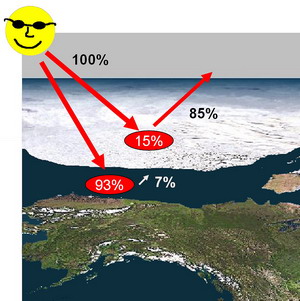
 Sea ice reflects as much as 85% of solar radiation hitting the surface, hence absorbing only 15%. Ocean water, by contrast, reflects only about 7% of solar radiation, absorbing 93%.

If this was dry wind blowing across  Greenland, it would only contribute sensible heat to the ice.  The air would cool both by contact with the ice and the expansion of air as it rose up the slope.  However with a high water vapor content, some of the latent heat of the condensing water vapor stays in the air.  

You remember, in our example we started with 10 degrees C, fully saturated air.  At a little over a km in altitude, it would have cooled to zero degrees and would stop melting the ice.  However some of the latent heat which is released as water vapor condenses into droplets (fog), the air will remain above zero degrees to a higher altitude, all the while melting the ice.

Of course the situation get's rapidly worse as the air becomes warmer than the 100 C we took as our example and the water vapor content of the air increases.  Have a look back at the table. 

While we are at it, there is another scenario that may be relevant to the story of a melting Greenland.  

Suppose there isn't much wind but Greenland is bathed in war moist air right to the top.  This air is light (relatively) due both to it's temperature and it's water vapor content.  That's right.  Humid air is lighter than dry air.  The reason is interesting and explained below.  It is in contact with the ice.  The ice cools this air and condenses out some of the water vapor making it heavier.  If the droplets of water stay in the air as fog, this exacerbates the effect.  This air now begins to flow down the slope as a density current.

You remember the lapse rate.  It works in the other direction too.  For every km that this air flows down the slope (vertical kilometer), it warms by 9.8 degrees C.  by compression.  Of course, it doesn't actually warm.  It transfers this heat to the ice, melting it.  These are the the famous Piteraqs that are seen around the shores of Greenland.   

A body of air flowing from the very top of Greenland to the sea would warm almost 30 degrees if it didn't gain or loose heat.  This heat plus the latent heat of water vapor condensing on the ice is available to melt the ice.  We should see some rather extreme melting events in the future.

Relative density of gases  
Gases have some interesting properties.  The volume of a gas is inversely related to pressure (if you keep temperature constant).  That is to say, if you double the pressure, you half the volume.  The volume of a gas is directly related to temperature.  Not Centigrade but Kelvin temperature otherwise known as absolute temperature.  This is temperature measured from absolute zero.  If you increase the temperature of a liter of a gas, for instance, from zero degrees centigrade (2730K) to 100 degrees centigrade (3730K) then the volume will increase by 373/273 =  1.37liters.

Leaving all this aside, let's get on to the really interesting aspect of gases.  It turns out that a given volume of any gas at the same temperature and pressure contains the same number of particles.  I say particles rather than atoms since many gases exist as molecules of two atoms such as N2, O2 and H2.  This has an interesting implication.  If you know what gas you have, you can work out it's relative density to, for instance, air.

Now air is a combination of mainly Nitrogen and Oxygen.  An atom of Nitrogen has an atomic weight of 14 so each N2 atom is 28.  Oxygen, similarly has an molecular weight of 32.  So air is approximately 30 (I should have done a weighted average but we are just illustrating the principle).  Water vapor consists of two hydrogen atoms and one oxygen atom so has a relative weight of 18.  Water vapor is only 18/30 = 3/5ths or 60% as dense as air.  Now we need one more property of gases.

When you put sugar into water it dissolves and  to some extent the sugar fits between the water molecules.  The volume of the sugar and the water is somewhat less than the volume of the water and the sugar added together.  Gases are not like this.  Each molecule occupies the same volume as any other molecule.  So if you add a tenth of a liter of water vapor to a liter of air (with no condensation, of course) you end up with 1.1 liter of gas.

You can see, therefore, that humid air which is a mix of water vapor (relative density 18) and air (relative density 30) is lighter than dry air.

All bets are off, of course, if the water vapor condenses into fog.  Now you have a suspension of water droplets in air and it is heavier than dry air.

So we have a couple of mechanisms that could cause a rather striking acceleration in the melting of the surface of Greenland.


Thursday, October 25, 2018

The End of the Ice Age

Sorry to rain on your parade but it ain't over.  We are still in the middle of an Ice Age.  It has been going on for about 2.8million years and is not over.  It is actually, if named  correctly, an epoch.  Namely the Pleistocene Epoch.  This Epoch is colloquially called the Ice Age.

During the Pleistocene Epoch (Ice Age)  there have been many icy periods (Glacials or glacial periods) and relatively ice free periods (Interglacials or Interglacial periods).  We are at present in the Holocene Interglacial and the previous one around 125,000 years ago was the Eemian Interglacial. Between the Eemian and the Holocene Interglacials was a glacial period in which glaciers extended from the Arctic to a bit past the American Canadian border. You could say that the Holocene Interglacial started 20,000 years ago since that was the peak of the previous Glaciation but melting really got underway a little less than 12,000 years ago so that is usually taken as the beginning of the Holocene Interglacial.

We should already be beginning our slide into the next Glacial period (not Ice Age - remember, we are still in an ice age) but the plow, rice paddies and the destruction of forests slowed our slide into the next galcial just long enough for the Industrial revolution to kick in and send us into a warming phase.  Read Plows, Plagues and Petroleum by Ruddiman for chapter and verse on the plow, plagues and rice paddies.  Despite early (from about 8000 years ago) human influence delaying our slide into the next glaciation, we apparently were finally just starting into the next glacial period when the industrial revolution reversed the trend.

The final straw in our slide into the next Glacial was the demise of the population of North America due to European diseases and the black death in the 'Old world'  Both resulted in forests regrowing and the sucking down of Carbon dioxide just enough to start the accumulation of snow way up on the high lands of Baffin Island.  Apparently there is still a halo of dead lichens around this area where the expanding permanent ice and snow killed the lichen.  Green house gases then increased enough to reverse the accumulation of snow.

Some scientists are predicting that we are going into a sort of Maunder Minimum in which sun activity decreases.  No way, though, that this will reverse our warming.  We have put way too much Carbon dioxide into the atmosphere.

Our output of green house gases, by the by, long before the industrial revolution, is the explanation of why this interglacial has been so much more stable, weather wise, than previous interglacials.

With our output of Green House Gases and especially Carbon dioxide, we have put off the next glacial and with a little luck we may put it off until the next Interglacial.

However, we now have too much of a good thing and it is time to put carbon back into the soil, into trees and to stop adding more to our atmosphere.  We have the technology.  Any reasonably bright year 12 student could tell the politicians exactly what they should be doing but the politician won't listen.  They want to be elected next time and need the money from the vested interests to succeed.  Until we make it illegal for anyone to contribute anything to any politician for any reason whatsoever, we will be pushing the brown stuff uphill with a spoon.  Never was the old adage, Who Pays the Piper Calls the Tune more true.

One of the barriers to the use of renewable energy is it's unpredictability.  In the long term, you know more or less how much wind and sunshine you will get at any location but it comes in unpredictable booms and busts.  There are may fixes including notably,  demand balancing of our grids (electricity priced to reflect the extent of availability over  demand and devices that use electricity selectively when it is most available and hence least expensive).  However, a really good battery for stationary applications would go a long way to help.  Fortunately there are technologies in the wings, which could fill in the gaps left by other methods and systems.  There are Vanadium and Iron flow Batteries,  Liquid metal batteries and  the Zinc bromide flow and gel batteries.

It looks like we are over the hump.  Tesla sold a mega battery to a wind farm in Australia.  What is particularly significant is that it is on track to produce revenue equal to a third of it's capital cost by the end of the first year of operation.  Economics trumps all other motivations.  This could be even better if the alternate battery technologies take off and become less expensive than Li batteries.

You might ask yourself, why I get so up tight over terminology - namely the misuse of the term Ice Age.    You will see in the popular literature and even in scientific papers, the use of the term Ice age to mean the glacial period between the present Holocene interglacial and the previous Eemian interglacial.  Why is this important.  We as humans are prone to lie to ourselves.  For instance, we note that the megafauna of North America disappeared when the Ice Age ended.  And we admit that man might have had something to do with it but it was probably climate change.  Nonsense.

First, as I said, we are still in an Ice age.   (The Pleistocene Epoch to be totally correct) so it hasn't ended.  But that is the least of the deception.  The Mega Fauna survived repeated cycles of glacials and interglacial and depending on how you define them, there have been between 30 and 50 such cycles within the present ice age (Pleistocene epoch).

No, the NA mega fauna disappeared at the end of the most recent Glacial period.  They survived quite happily the end of many previous Glacials and the subsequent interglacial and only the recent one caused their demise.  The only difference was the arrival of the first people who ate their way through these animals from one end of the Americas to the other.  If you don't think that primitive hunters could wipe out the mega fauna of the Americas, just look at the extinctions in Australia (50,000 years ago) and New Zealand (700 years ago) or in  any other  area when man first arrived.   Now we are finishing the job with habitat destruction.  Soon we will be alone in the world and then pooooof.   We are Gone Burgers. Evolution can begin again from whatever remnants remain.

ps.  Note that there are indications that around 12,000 years ago, there was a major meteorite hit on North America which left a layer of sediment recording it's existance.  This could have had an effect on the fauna of North America but there would only need to be a few 'refugia' left for the animals to make a come back.  Future work may shed more light on this possibility.

The Anthropocene actually started at different times in different locations with the arrival of man.  So much for first people being the guardians of nature.  In actual fact, they eliminated any animal that they could hunt faster than it could reproduce. Now modern man is finishing the job.